

- Scheduling
- Eligibility
- Provider workflow
- Patient communication
- AI Receptionist
- Task automation
Behavioral Health Practice Operating System
Manage the Complete
Patient-to-Payment Cycle
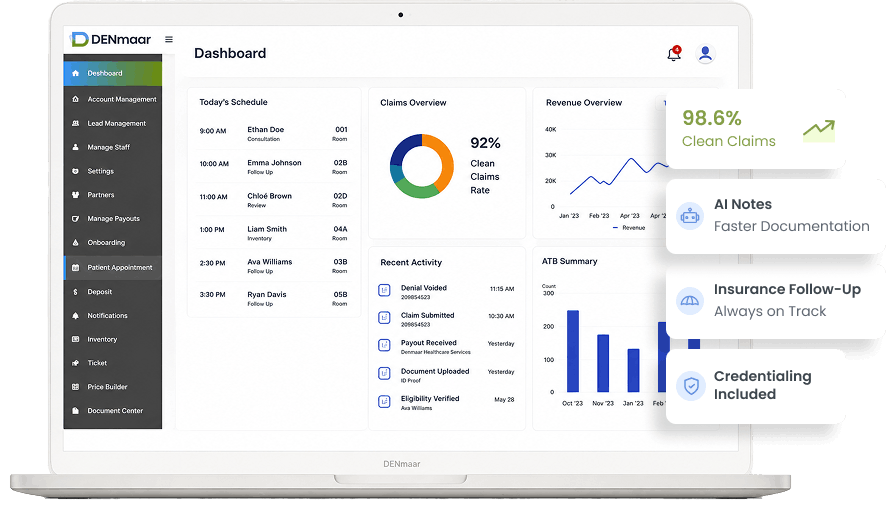
From the first patient call through scheduling, documentation, claims, and payment, DENmaar connects the work of your practice and automates routine steps.

Run your entire practice from one intelligent platform backed by behavioral health expertise.

AI-powered workflows
Behavioral health expertise
ONE INTEGRATED PLATFORM
Four Solutions. One Platform.
Everything growing behavioral healthcare organizations need to run a modern practice.
AI Clinical Documentation
Create therapy, psychiatry, group, and multidisciplinary documentation in minutes with AI designed specifically for behavioral healthcare.
Revenue Cycle Management
Professional insurance billing, payment posting, denial management, patient responsibility, eligibility verification, credentialing, and financial reporting.
More than software.
A complete revenue cycle solution.

AI Practice Automation
Administrative work should happen automatically whenever possible.
Insurance Knowledge Team
Healthcare reimbursement is constantly changing. DENmaar includes access to an expanding insurance knowledge platform built specifically for behavioral healthcare.
Get guidance on:
- Coding
- Prior authorization
- Documentation
- Claim resolution
- Medical necessity
- Credentialing
- Insurance requirements
- Best practices
Built from thousands of real-world behavioral health billing scenarios.

BUILT TO SCALE WITH YOU
Designed for Growing Practices
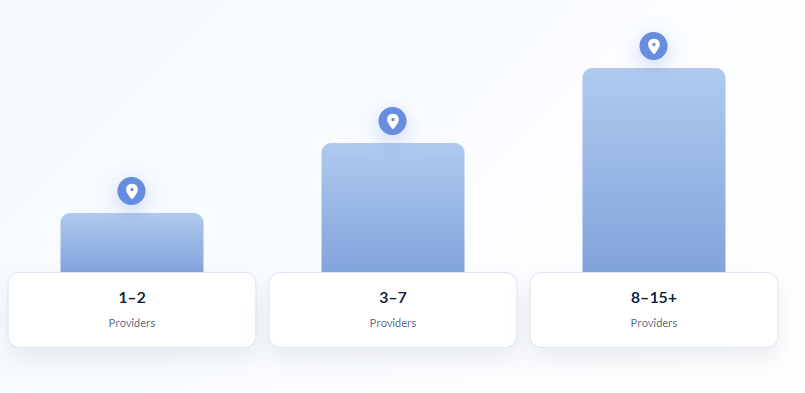
Whether you’re adding your second provider or expanding into multiple locations, DENmaar grows with your organization.
Start simple.
Get up and running quickly with the essentials.
Add capabilities
Unlock advanced features as your needs grow.
Never outgrow
A platform that scales with your vision.
THE DENMAAR DIFFERENCE
Why DENmaar?
Most vendors sell software. Others sell billing services. DENmaar combines technology, AI, revenue
cycle management, and behavioral health expertise into one integrated platform.
Most vendors sell software.
Technology without the operational expertise to connect the pieces.
Others sell billing services.
Services without the intelligent platform to automate your practice.
DENmaar combines it.
Technology, AI, revenue cycle management, and behavioral health expertise into one integrated platform.
Enterprise Capability.
Small Practice Simplicity.
Schedule Your Personalized Demo
See how DENmaar can help your practice grow with confidence.
Let’s Determine Whether There Is Operational Alignment
We begin with a discussion focused on:
- Organizational structure
- Insurance workflows
- Operational goals
- Implementation fit
Request Information
Capterra, Software Advice And Get App 2023 / 25
Best Of Badges Awarded To DENmaar
2023 / 25 “Best of” badge winners = DENmaar Neuro has earned a well-deserved Best Value Badge.
See our reviews for our software being recognized as an impactful solution for your business.





Our Latest Blogs
What “Claims Hygiene” Really Means in Behavioral Health
And Why Most Practices Are Fixing It Too Late
Most behavioral health practices think claim problems start in billing.
They don’t.
By the time a claim reaches a billing team, the outcome is already largely determined. Denials, rejections, underpayments are usually symptoms of upstream breakdowns that occurred days or weeks earlier inside the EHR.
We call this claims hygiene.
And if it is not engineered into your system, no amount of billing follow-up will fully fix it.
For a deeper breakdown of structured prevention, see claims hygiene in behavioral health billing.
Claims Hygiene Defined
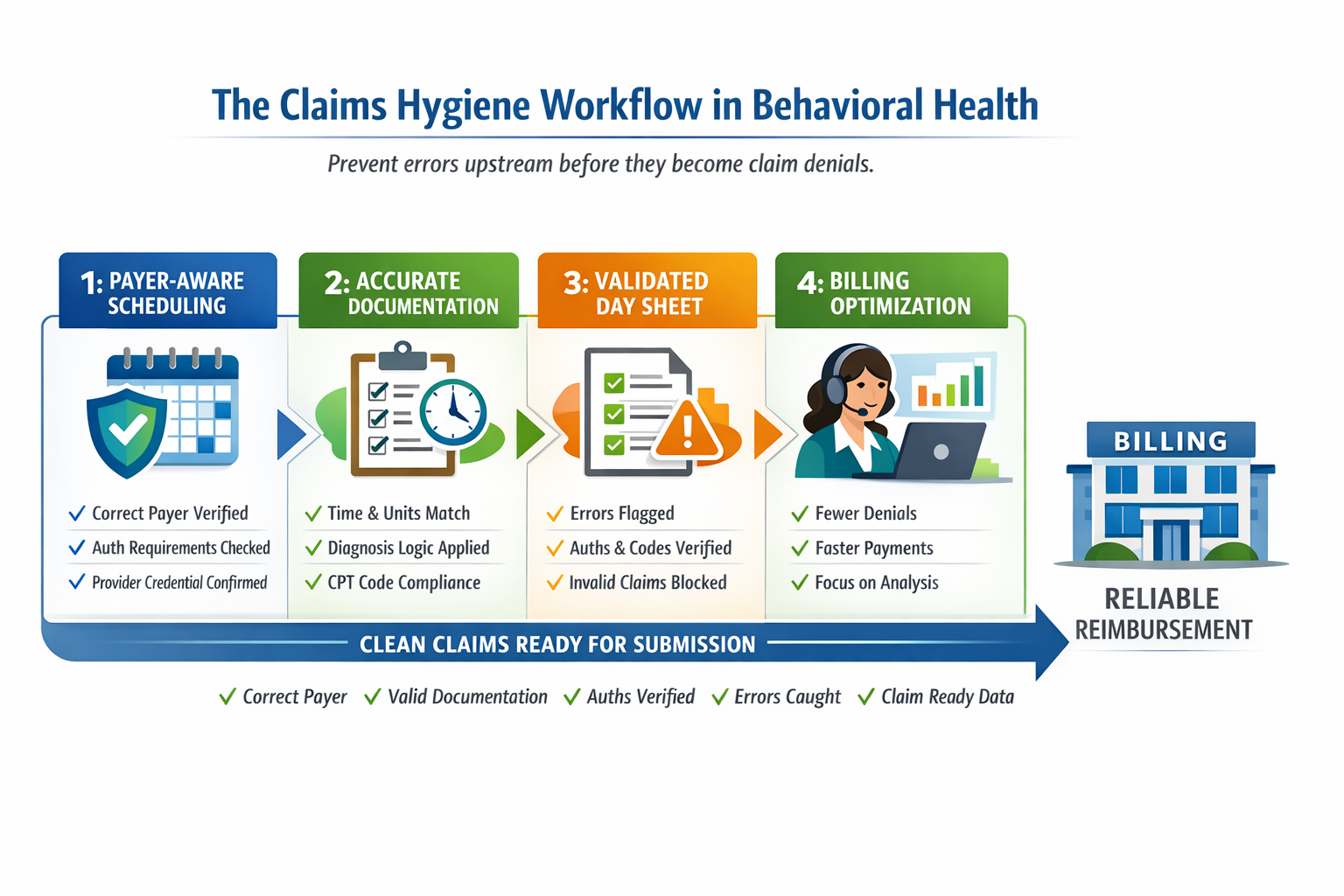
Claims hygiene is the condition where every step before claim submission is structurally aligned to produce a payable claim by default.
That includes:
- Correct payer identification, especially mental health carve-outs
- Authorization-aware scheduling
- Time and unit accurate documentation
- Diagnosis logic that matches the service performed
- Day sheet logic that enforces payer rules before release
When these elements are clean and coordinated, billing becomes simple.
When they are not, billing becomes damage control.
This is not just a billing workflow. It is behavioral health revenue cycle management designed upstream inside the EHR.
Where Claims Actually Break (Upstream, Not in Billing)
In behavioral health billing, especially in Medicaid billing behavioral health environments, claim failure usually originates in one of four places:
1. Scheduling Without Payer Logic
Appointments are booked without confirming:
- The correct mental health payer
- Whether the service requires authorization
- Whether the provider is credentialed for that payer or program
Once the visit happens, the financial risk is already locked in.
Without integrated provider credentialing and insurance credentialing services awareness, scheduling becomes financially blind.
2. Documentation That Is Clinically Fine but Billing Unsafe
Notes often fail not because they are poor clinically, but because:
- Time thresholds do not match billed units
- Services rendered do not align with diagnosis logic
- Required elements for specific CPT or HCPCS codes are missing
Billing teams cannot fix documentation that was never structured correctly.
This is where structured AI documentation for behavioral health, including AI powered progress notes, becomes critical. Documentation must be payer aware, not just clinically complete.
3. Day Sheets That Do Not Enforce Rules
The day sheet is the last gate before claim submission and in many systems, it is passive.
If a day sheet allows:
- Invalid unit counts
- Missing authorizations
- Diagnosis and code mismatches
Then the system is allowing bad claims to exist.
A strong behavioral health EHR and mental health EHR software platform should enforce payer logic before claims are generated
4. Billing Teams Forced Into Manual Recovery
This is where most practices focus, but it is already too late.
At this stage, billing teams are:
- Correcting errors they did not create
- Appealing preventable denials
- Chasing missing information retroactively
This is not revenue cycle management. It is revenue triage.
True behavioral health billing services should prevent these breakdowns before submission.
Why “Clean Claims” Is the Wrong Goal
Many platforms advertise clean claim rates, but that metric is misleading.
A claim can be clean to a clearinghouse and still:
- Hit the wrong payer
- Violate MCO rules
- Fail authorization requirements
- Deny weeks later
True clean claims in behavioral health are payer true, service true, and rule true before submission ever happens.
This is especially critical in Medicaid claims behavioral health, psychiatry billing Medicaid, and substance use treatment billing environments where CMS 1500 versus UB 04 differences and managed care carve-outs matter.
Why Scaling Makes This Worse Fast
At 1 to 2 providers, errors are survivable.
At 10 or more providers:
- Small inconsistencies become systemic revenue loss
- Training breaks down
- Manual checks do not scale
- Billing headcount grows without fixing root causes
This is why many practices hit a ceiling where revenue plateaus despite growing volume.
Scaling requires system enforced behavioral health compliance, not manual memory.
What Real Claims Hygiene Looks Like
In a hygienic system:
- Insurance verification identifies mental health carve-outs automatically
- Scheduling is constrained by authorization and credentialing reality
- Documentation enforces time, units, and service logic
- Day sheets block invalid claims by design
- Billing teams focus on optimization, not cleanup
When this is in place, practices typically see:
- Fewer rejections and denials
- Faster payment cycles
- Lower billing staff burnout
- 10 to 20 percent improvement in realized insurance revenue without adding patients
This is the difference between submitting claims and building a revenue safe behavioral health system.
The Core Insight
Claims hygiene is not a billing function.
It is a system design problem.
If your EHR allows bad data to flow freely, billing will always be reactive.
If your system enforces payer aware logic upstream, billing becomes predictable and scalable.
Learn more about system level prevention at DENmaar.
Final Thought
Most practices do not need better billers.
They need fewer preventable mistakes.
Claims hygiene is not something you fix after the fact.
It is something you engineer into the workflow.
That is the difference between submitting claims and building a revenue safe system.
Frequently Asked Questions
What is claims hygiene in behavioral health billing?
Claims hygiene is the upstream enforcement of payer logic, authorization requirements, diagnosis alignment, and documentation accuracy before claims are submitted.
Why do Medicaid behavioral health claims deny so often?
Most denials stem from incorrect payer identification, missing authorizations, credentialing mismatches, or documentation errors created before billing ever sees the claim.
Can billing teams fix documentation errors?
No. Billing teams can correct coding or submission issues, but they cannot retroactively fix structurally flawed documentation.
How does an EHR improve clean claim rates?
A behavioral health EHR that enforces payer aware logic, authorization validation, and structured documentation reduces preventable denials before submission.
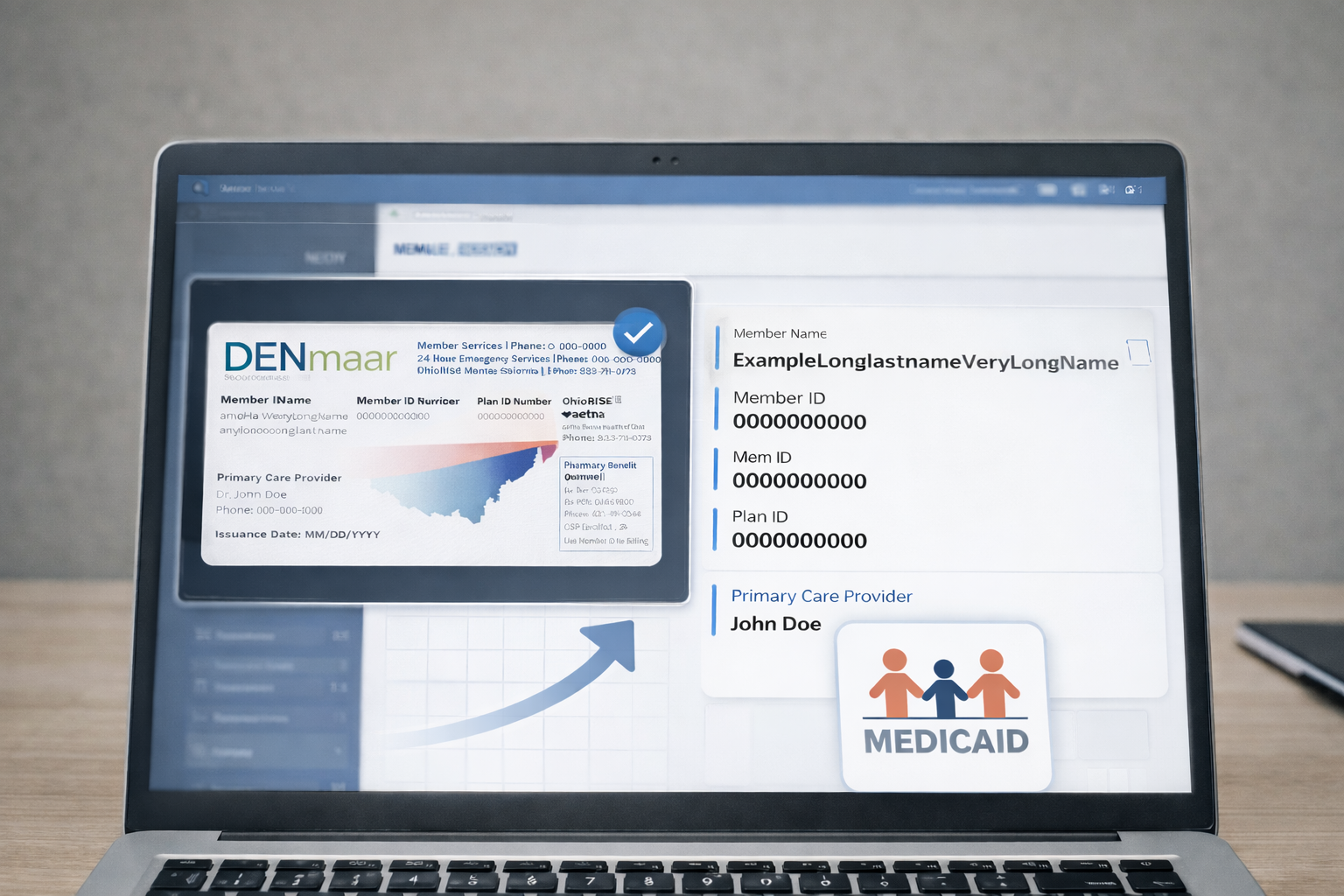
AI Insurance ID Card Reader for Mental Health Carve-Outs and Medicaid MCOs
Behavioral health billing has many pain points—documentation, coding, authorizations—but one of the most persistent is the insurance ID card itself.
Mental health benefits are often carved out from the medical plan. Medicaid members may be assigned to a medical MCO that is not the behavioral health payer. Insurance cards frequently list multiple phone numbers and logos with little clarity on who actually pays for services.
This is exactly the problem DENmaar’s AI Insurance ID Card Reader is designed to solve.
The Core Problem With Insurance ID Cards in Behavioral Health
In behavioral health, the payer printed on the insurance card is often not the payer you should bill.
Common scenarios include:
-
Commercial medical plans where mental health benefits are administered by Carelon Behavioral Health or Optum Behavioral Health
-
Medicaid members enrolled in a medical MCO while behavioral health is carved out to a separate entity
-
State-specific Medicaid structures where:
-
Physical health is billed to one payer
-
Mental health is billed to another
-
Substance use services may be billed to a third
-
Traditional EHR systems treat the insurance card as a static image. DENmaar treats it as structured intelligence.
How the AI Insurance ID Card Reader Works
When an insurance card is uploaded or captured, DENmaar’s AI does more than store it—it interprets it.
Automated Data Extraction
The AI reader extracts:
-
Payer name and plan name
-
Member ID and group number
-
Plan type (Medicaid, commercial, Medicare)
Behavioral Health Intelligence
The system:
-
Detects behavioral health carve-out indicators
-
Flags when the listed payer is medical-only
-
Triggers automated downstream verification logic
This transforms the insurance card into the first step of a clean claims workflow, not a future problem.
Mental Health Carve-Out Detection (The Key Differentiator)
DENmaar’s AI is trained specifically on behavioral health carve-out patterns, not generic eligibility rules.
Examples include:
-
Anthem or Blue Cross medical cards with mental health routed to Carelon
-
UnitedHealthcare medical plans with behavioral health managed by Optum
-
Medicaid MCO cards where behavioral health is administered by a state-designated carve-out entity
Instead of discovering these issues after denials, the system:
-
Flags carve-outs during intake
-
Assigns the correct behavioral health payer automatically
-
Prevents claims from being submitted to the wrong entity
This alone eliminates a large percentage of avoidable payer rejections.
Medicaid MCO Detection and Multi-Payer Awareness
Medicaid is where most EHRs struggle.
DENmaar’s AI Insurance ID Card Reader:
-
Recognizes state-specific Medicaid MCO card formats
-
Identifies when the MCO covers medical services only
-
Routes mental health services to the correct payer
-
Supports multi-payer logic across:
-
Therapy services
-
Psychiatry
-
Community-based care
-
Higher levels of care
-
This is critical for behavioral health organizations operating across multiple states with varying Medicaid rules.
Operational Impact for Behavioral Health Practices
For practices, this translates into:
-
Fewer intake errors
-
Cleaner eligibility records
-
Accurate payer mapping from day one
-
Fewer denials due to incorrect payer submission
-
Less staff time spent calling payers just to find the correct number
For DENmaar, it reinforces a core principle: save time while staying compliant.
Built for Scalable Behavioral Health Organizations
This system is not designed for one-off workflows or solo workarounds. It is built for:
-
Multi-provider practices
-
Multi-state behavioral health organizations
-
Medicaid-heavy patient populations
-
Teams that prioritize predictable cash flow over constant cleanup
For organizations planning to scale, this level of automation is no longer optional.
The Bigger Picture: Intake-to-Billing Intelligence
The AI Insurance ID Card Reader is not a standalone feature. It is a gateway to:
-
Accurate eligibility verification
-
Correct behavioral health payer assignment
-
Clean claims submission
-
Scalable, denial-resistant billing operations
It represents where DENmaar is headed: intake-to-billing intelligence built for how behavioral health actually works.

Leaning Into DENmaar, Not Leaning On It
A Balanced Platform, Backed by Real Services
In behavioral health technology, there is a distinction that matters more than most people realize.
There is a difference between leaning into a system and leaning on it.
At DENmaar, this distinction is foundational, not just to our technology, but to how our services team operates alongside it.
The Risk of Leaning On Technology Alone
Many platforms sell the idea that software, by itself, will solve operational complexity. The implication is:
Once it is turned on, the system will take care of everything.
In real-world healthcare operations, this creates fragility:
- Automation without context
- Black box workflows no one owns
- Errors that surface downstream instead of being prevented upstream
- Teams reacting to problems instead of steering outcomes
Behavioral health, especially in Medicaid, Medicare, and multi-payer environments, does not tolerate that kind of opacity.
What It Means to Lean Into DENmaar
Leaning into DENmaar means treating it as an engineered operating system, supported by people who understand both the technology and the work.
This looks like:
- Workflows designed to match real clinical and billing behavior
- Payer logic made explicit, not assume
- Automation that flags, routes, and clarifies, not hides
- Human oversight where judgment is required
Technology does the heavy lifting.
People ensure correctness.
Technology Backed by a Services Team
This is the balance many platforms miss.
DENmaar is not software only, and it is not services first. It is a tightly integrated model where each reinforces the other.
Our behavioral health billing services team:
- Actively monitors claims performance
- Reviews and corrects issues before submission
- Aligns documentation with payer expectations
- Feeds real-world edge cases back into the system
At the same time, the DENmaar behavioral health EHR platform:
- Reduces manual effort for the services team
- Standardizes decisions so fixes are repeatable
- Prevents the same issues from recurring
- Scales knowledge across every account
This prevents heroics. The system improves instead.
Balance Over Automation Theater
DENmaar is built at the intersection of:
- Clinical compliance
- Behavioral health revenue cycle management
- Operational efficiency
Leaning too hard on any single dimension creates risk:
- Compliance without efficiency leads to burnout
- Efficiency without oversight leads to denials
- Revenue focus without clinical grounding leads to audits and instability
Our rule is simple:
If automation removes friction and preserves correctness, it belongs in the system.
If it obscures accountability, it does not.
That is why our platform is paired with a services team that understands how payers behave in practice, not just how they behave on paper.
Where We Apply Leverage
We lean in where leverage compounds:
- Claims hygiene before submission
- Structured, payer-aligned documentation
- Eligibility and authorization logic upstream
- Automation that drives clear next actions
- Human review where payers are inconsistent or subjective
We do not lean on technology to:
- Mask broken workflows
- Replace operational ownership
- Handle edge cases without review
- Chase novelty at the expense of stability
Built for Operators, Not Passivity
DENmaar is designed for practices that are building something durable:
- Multi-provider organizations
- Programs with payer complexity
- Leaders who value predictability over hype
The platform does not replace teams. It supports disciplined teams with better systems, including AI-powered progress notes that remain payer-aware and compliant.
The Long View
Strong healthcare platforms age well.
They become more valuable over time because:
- Errors are eliminated at the source
- Knowledge is retained in the system
- Services and software evolve together
- Operators spend less time reacting and more time leading
That is what it means to lean into DENmaar, not lean on it.
And that balance, technology backed by a services team, is how durability is built.
Frequently Asked Questions
What makes DENmaar different from software-only behavioral health platforms?
DENmaar combines behavioral health EHR technology with hands-on billing and services support to prevent errors before claims are submitted, rather than reacting after denials occur.
Does DENmaar support Medicaid and multi-payer environments?
Yes. DENmaar is built for Medicaid-heavy behavioral health practices and supports payer-specific logic, compliance requirements, and clean claims workflows.
How does DENmaar improve clean claim rates?
Through upstream claims hygiene, payer-aligned documentation, and service-aware automation supported by human review.
Is DENmaar suitable for growing behavioral health organizations?
DENmaar is designed for practices scaling across providers, services, and payers that need predictable revenue cycle performance.
Our Partners






Ready to get started?
Feel free to reach out if you have any questions.
