

Reduce payer friction, improve billing workflows, and support stronger reimbursement performance with behavioral-health-focused insurance knowledge built into the DENmaar platform.
Insurance Knowledge Team
Technology Alone
Doesn't Get Claims Paid.
Knowledge Does
Behavioral health reimbursement is constantly changing. Payer rules, modifiers, priorauthorizations, telehealth requirements, documentation standards, and state-specific billing policies create challenges that software alone cannot solve. DENmaar combines technology with a dedicated Insurance Knowledge Team focused exclusively on behavioral health reimbursement.

Behavioral Health Reimbursement Expertise

Operational support beyond software

Shared knowledge that strengthens outcomes

Built Specifically for Behavioral Health
Reimbursement support that understands
behavioral health complexity.
Our team works alongside providers and billing staff to navigate payer requirements, resolve
reimbursement issues, and continuously improve billing outcomes

Behavioral Health Expertise
Our team specializes exclusively
in behavioral health reimbursement
across all payer types.
in behavioral health reimbursement
across all payer types.

Payer Intelligence
Our team specializes exclusively
in behavioral health reimbursement
across all payer types.
in behavioral health reimbursement
across all payer types.

Continuous Research
Our team specializes exclusively
in behavioral health reimbursement
across all payer types.
in behavioral health reimbursement
across all payer types.

Better Reimbursement
Our team specializes exclusively
in behavioral health reimbursement
across all payer types.
in behavioral health reimbursement
across all payer types.
AREAS OF EXPERTISE

Commercial Insurance

Medicaid managed care

Medicare

Telehealth Billing

Prior Authorizations

Denial Management

Credentialing Support

Documentation Requirements

Behavioral Health Coding
How the Insurance Knowledge Team Works
A practical reimbursement support model that
turns payer complexity into operational clarity.
Every reimbursement issue becomes an opportunity to improve claim outcomes, strengthen workflows,
and make the DENmaar platform smarter over time.
1
Identify barriers
We identify reimbursement
challenges and payer roadblocks.
challenges and payer roadblocks.
2
Research Requirements
We research payer-specific requirements, rules, and policy updates.
3
Develop Strategy
We develop effective resolution strategies and best practices.
4
Share Knowledge
We share insights across the organization and client community.
5
Improve Workflows
We improve workflows to prevent recurring issues and denials.
6
Support Providers
We support providers
and billing teams every step of the way.
and billing teams every step of the way.
Knowledge That Improves the Entire Platform
Every reimbursement issue creates intelligence that strengthens future billing performance.
Every payer issue, denial pattern, workflow challenge, and reimbursement insight contributes to improving the DENmaar platform. The result is a continuously evolving system that becomes smarter over time—not just for one claim, but across operational billing workflows.

Payer issue patterns
Track the recurring payer requirements and billing obstacles that repeatedly affect reimbursement outcomes.

Denial insight loops
Use denial and follow-up experience to improve resolution quality and reduce repeat claim friction.

Workflow refinement
Translate reimbursement knowledge into better operational workflows tied to billing readiness and claim quality.

Shared organizational learning
Knowledge gained through real payer interactions can inform future reimbursement decisions across teams and clients.
Support for Multidisciplinary Organizations
Insurance knowledge support across the services and programs behavioral health organizations actually run.
DENmaar’s Insurance Knowledge Team supports organizations across outpatient therapy, psychiatry, substance use treatment, intensive programs, community behavioral health, and multidisciplinary care environments.

Therapy Practices
Medication Management
Substance Use Treatment Providers
IOP & PHP Programs
Community Behavioral Health Organizations
Multidisciplinary Practices
Why Organizations Choose DENmaar
Technology-supported workflows backed by real reimbursement knowledge.
DENmaar combines behavioral health specialization, reimbursement research, payer insight, and operational workflow support to help organizations improve billing accuracy and financial performance.

Behavioral health specialization
Real-world payer expertise
Continuous reimbursement research
Technology-supported workflows
Shared knowledge across client organizations
Focus on reimbursement accuracy
Request an Insurance Workflow Review
Discover how DENmaar’s Insurance Knowledge Team can strengthen reimbursement operations.
Request Information
TESTIMONIALS
WHAT OUR CLIENTS SAY
On behalf of everyone at Meadowlark Counseling Services, I want to extend our sincere thanks for the continued improvements you and your team have made to the DENMaar EMR platform. We have been consistently impressed with both the functionality and user-friendly design of the system, which has made a meaningful difference in our day-to-day operations. The intuitive layout and ease of use have allowed our staff to spend less time navigating the system and more time focusing on client care. The regular updates and enhancements reflect your commitment to meeting the evolving needs of providers in the behavioral health and substance use treatment fields. We genuinely look forward to the new features introduced each month and appreciate how responsive the platform has been to the demands of clinical workflows. We have been so pleased with our experience that we’ve taken the opportunity to recommend DENMaar to other professionals in Pennsylvania who are working in the SUD field. Thank you again for your ongoing support and partnership. We are grateful to be working with a company that truly understands the needs of its users. KIndly, Becky Parks on behalf of the entire team at Meadowlark Counseling Services
I referred one of my colleagues Dr Aaron to you he is just starting g his psychology private practice and looking at where to start. I told him hands down you guys are the best billers and have a great EMR and team. He said he reached out just wanted to let you know!
FANTASTIC job keeping things rolling along with any and all of our billing concerns as well as responding to other issues which may well have been out of your wheelhouse. We are VERY grateful to have you and the crew in our corner.
I appreciate you all so much and DENmaar has been such a blessing Donna to our overall operations and success as an expanding company—allowing us to ultimately operate more efficiently, get our claims paid more consistently, ad stay on top of the critical credentialing piece, among other things. Teamwork does in fact, make the dream work. I’ll loop Chris/Isabella in on this message thread too, as I want All of your team to be aware of how much we appreciate our working relationship with DENmaar
Thank you for your diligence!! I appreciate it so much. Thank you Edwina…
Thank you so much Amy! I will be referring to DENmaar as often as I am asked about credentialing services.
Our Latest Blogs
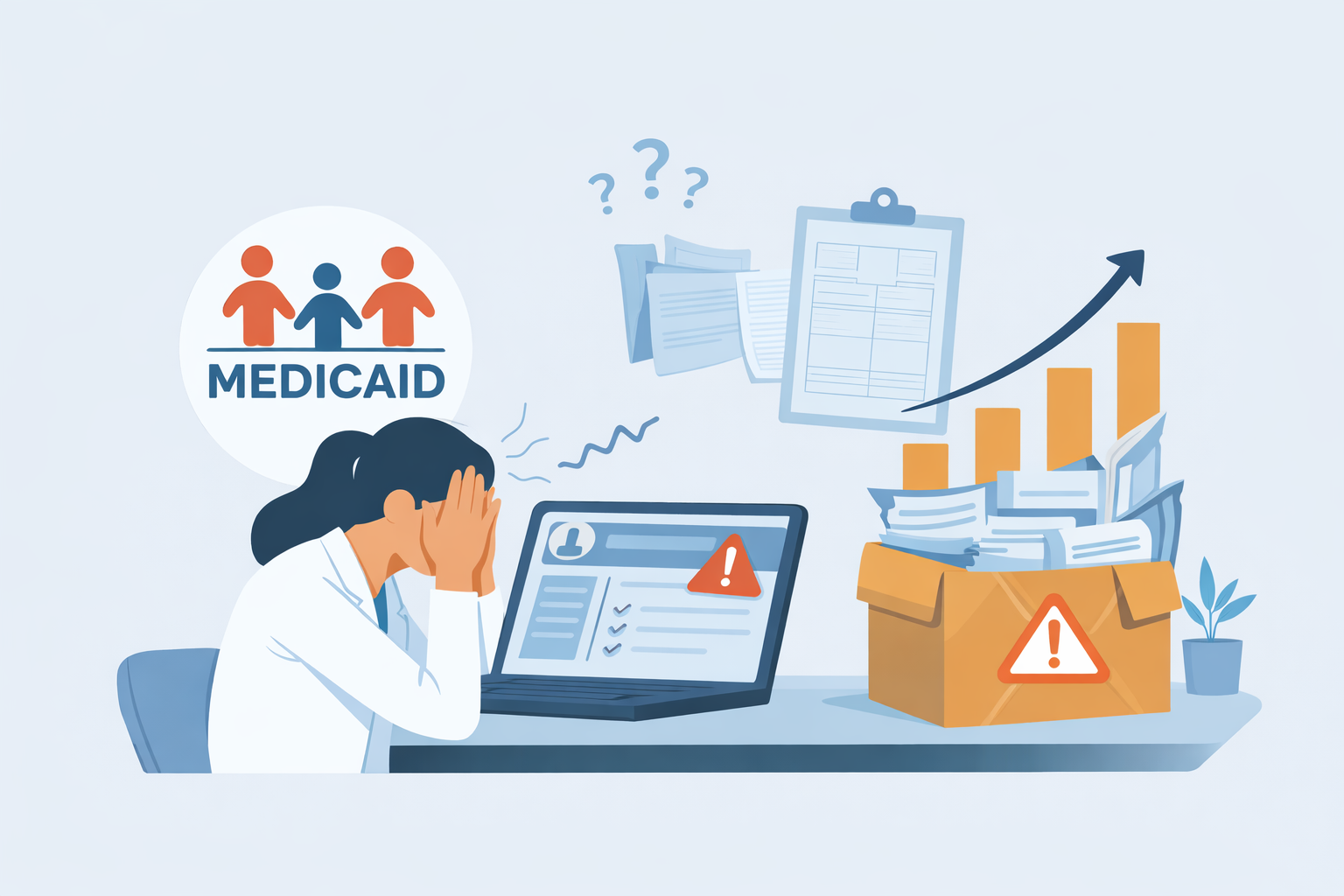
Why Medicaid Heavy Behavioral Health Practices Are Being Forced to Outgrow Their EHRs
Behavioral health practices did not suddenly become “too complex”. The system around them did.
Over the last several years, outpatient therapy and substance use disorder organizations, especially those serving Medicaid populations, have been pushed into operating models their software was never designed to handle. What used to work for low volume, private pay therapy breaks quickly once programs, units, authorizations, and state rules enter the picture.
That is why many Medicaid heavy practices are quietly outgrowing their EHRs. Not because they want more features, but because they need systems that reflect reality.
Many organizations discover this gap only after running into limitations with their existing behavioral health EHR platforms built for Medicaid complexity.
The Shift No One Planned For
Most behavioral health EHRs were built around a simple assumption.
- One provider
- One session
- One CPT code
That assumption no longer holds.
Today’s Medicaid dominant therapy and substance use disorder practices operate with:
- Multiple service lines including therapy, groups, substance use disorder care, and case management
- Unit based billing tied to time, staffing, and programs
- Authorizations that govern what can be billed, when, and how often
- State specific Medicaid rules layered on top of managed care organization requirements
- CMS-1500 and UB-04 billing existing side by side
None of this is edge case behavior. It is the default for serious outpatient Medicaid care.
Organizations navigating this shift often encounter confusion around CMS-1500 vs UB-04 billing for behavioral health organizations.
Where Traditional EHRs Start To Fail
Most EHRs do not break all at once. They fail quietly, in predictable ways.
Documentation Is Not Billing Aware
Progress notes are treated as clinical artifacts, not revenue drivers. Units, modifiers, place of service, and enrollment logic live outside the note, usually in spreadsheets or billing staff memory.
This disconnect creates friction between clinical teams and behavioral health billing services for Medicaid programs.
Medicaid Is Treated As A Payer, Not A System
Checking a Medicaid friendly box does not account for:
- State program enrollment requirements
- HCPCS driven services
- Group and per diem logic
- Hybrid billing models
What is required by the Centers for Medicare and Medicaid Services at a policy level looks very different when executed by states and managed care organizations.
Growth Exposes Operational Ceilings
As volume increases, practices feel it:
- Claims slow down
- Denials rise
- Staff productivity drops
- Founders become the bottleneck
The issue is not demand. The issue is that the system was never built to scale Medicaid complexity.
The Hidden Cost of Workarounds
Most practices do not replace their EHR immediately. They adapt around it.
They add:
- Manual billing checks
- Custom spreadsheets
- Staff tribal knowledge
- Rework after rejections
- Founder oversight to keep things moving
This works until it does not.
Every workaround introduces risk:
- Compliance drift
- Revenue leakage
- Burnout
- Inconsistent outcomes
Eventually, the practice hits a ceiling that has nothing to do with clinical quality and everything to do with system design.
What Medicaid Ready Systems Actually Need To Do
A system built for Medicaid heavy behavioral health must:
- Understand units, groups, and programs natively
- Tie documentation directly to billing logic
- Support CMS-1500 and UB-04 workflows without forcing a choice
- Adapt to state specific rules instead of ignoring them
- Reduce dependency on hero staff and founder intervention
This is not about adding more buttons. It is about embedding institutional knowledge into software.
Practices exploring modern mental health EHR software for complex care models often discover this requirement too late.
The Future Systems and Insurance Intelligence
The next generation of behavioral health platforms will not win on user interface alone.
They will win by:
- Increasing claims velocity
- Reducing denials before submission
- Shortening onboarding and credentialing timelines
- Making compliance invisible instead of manual
In Medicaid heavy environments, software without insurance intelligence becomes a liability. Practices are starting to recognize that documentation must also support billing logic through tools like AI progress notes aligned with Medicaid billing requirements.
A Quiet but Important Realization
Many therapy and substance use disorder organizations are not outgrowing their EHRs because they have become too ambitious.
They are outgrowing them because they are finally operating at the scale Medicaid care requires.
The practices that succeed long term will not be the ones with the most features. They will be the ones whose systems tell the truth about how Medicaid behavioral health actually works.
Frequently Asked Questions
Why do Medicaid behavioral health practices outgrow traditional EHRs?
Most legacy systems were built for simple outpatient therapy and cannot handle unit based billing, program enrollment, and state specific Medicaid rules.
Why is CMS-1500 vs UB-04 important in behavioral health billing?
CMS-1500 supports provider delivered services, while UB-04 is required for program based Medicaid services such as substance use disorder treatment, IOP, PHP, and rehabilitative care.
Can one EHR support both billing models?
Only Medicaid ready behavioral health EHRs can support both claim types without relying on spreadsheets, manual billing checks, or external systems.
How does documentation impact Medicaid reimbursement?
Documentation must align with authorizations, program requirements, and billing units. When it does not, claims are delayed or denied.
Is DENmaar built for Medicaid billing complexity?
Yes. DENmaar supports program-based services, AI documentation, billing workflows, and credentialing across multiple levels of care.
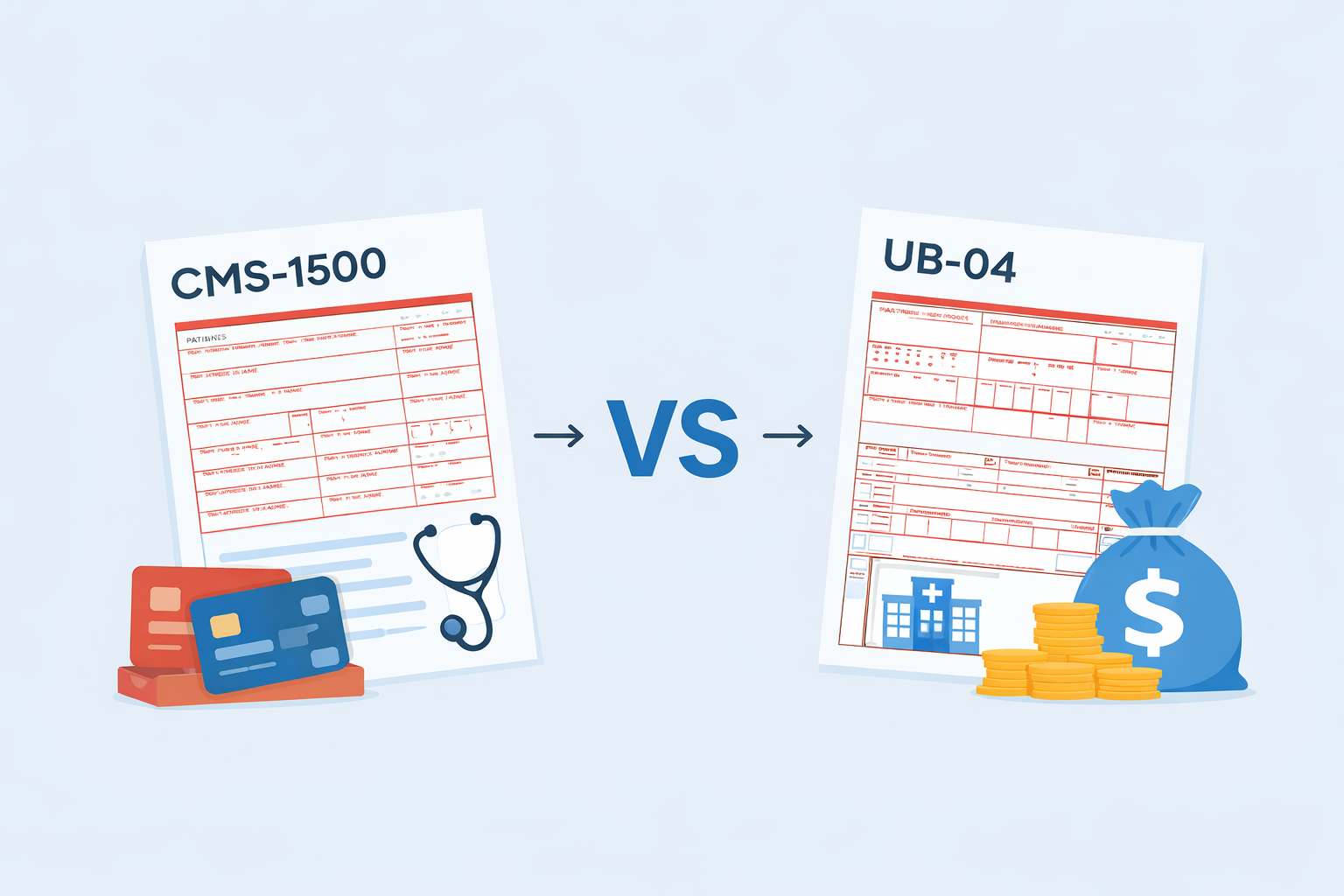
Medicaid Billing Isn’t One System
Understanding CMS-1500 vs UB-04 and the Services Behind Them
One of the biggest mistakes behavioral health organizations make with Medicaid is assuming that billing works the same way across services.
It doesn’t.
Medicaid behavioral health operates in two fundamentally different billing worlds, and most EHR platforms only support one of them. Understanding the difference between CMS-1500 and UB-04, and the services tied to each, is essential if your organization plans to grow beyond basic outpatient therapy.
The Two Medicaid Claim Types That Matter
CMS-1500: Professional Billing
CMS-1500 is used for clinician-delivered, outpatient services.
This is where most EHRs stop.
Typical services billed on CMS-1500 include:
- Individual psychotherapy (90832, 90834, 90837)
- Family and group therapy (90847, 90853)
- Diagnostic assessments (90791, 90792)
- Psychiatry and medication management (99202–99215)
- Psychotherapy add-on codes (90833–90838)
These services are:
- Provider-centric
- Session-based
- Not tied to program certification
- Familiar to most outpatient practices
For organizations offering only these services, CMS-1500 coverage may be sufficient.
Medicaid, however, extends far beyond this level of care.
UB-04: Institutional and Program-Based Billing
UB-04 is required for program-based Medicaid services, the services that operate under organizational enrollment, certification, and authorization rules.
These services typically use HCPCS codes, not CPT, and include:
- Adult rehabilitative or psychosocial rehabilitation services (H2015, H2017, H0036)
- Children’s therapeutic or wraparound services (H2019, H2021)
- Case management and care coordination (T1016, H0032)
- Substance use disorder treatment (H0001, H0004, H0005, H0015)
- Intensive outpatient and partial hospitalization programs
- Residential treatment services (H2036, H0018, H0019)
- Assertive Community Treatment (H0039, H0040)
- Day treatment and structured programs
- Crisis stabilization and crisis intervention services
These services are:
- Program-enrolled, not just provider-enrolled
- Authorization-driven
- Unit-based or per-diem
- Highly state-specific
- Often required to be billed on UB-04
This is where many EHR systems fail, not because the services are rare, but because they don’t fit a simple outpatient billing model.
The Real Challenge: Hybrid Organizations
Many behavioral health organizations operate both models at the same time.
A single organization may:
- Bill CMS-1500 for therapy and psychiatry
- Bill UB-04 for rehabilitative, substance use disorder, or higher levels of care
- Treat the same patient under both billing structures
- Employ clinicians who work across programs
Most systems cannot handle this cleanly.
The result is often:
- Separate EHRs
- External billing vendors
- Manual spreadsheets
- Claims held or denied due to enrollment mismatches
- Revenue leakage that isn’t obvious until months later
This complexity isn’t accidental. It is how Medicaid is designed.
Why Codes Alone Don’t Tell the Whole Story
A common misconception is that:
- CPT always equals CMS-1500
- HCPCS always equals UB-04
In reality:
- Program enrollment determines the claim form
- The same HCPCS code may be billed differently depending on:
- State rules
- Program certification
- Level of care
- Authorization structure
This is why Medicaid billing cannot be configured once and forgotten.
What a Medicaid-Ready Platform Must Handle
To properly support Medicaid services across levels of care, a platform must understand:
- Service type, professional versus program-based
- Program enrollment and certification status
- Claim-type logic, CMS-1500 versus UB-04
- Authorization requirements and unit limits
- Documentation standards tied to the service, not just the code
- State-specific compliance rules
Without this foundation, billing accuracy depends entirely on manual work.
See how AI-enabled documentation supports this logic:
AI documentation designed for behavioral health programs
Automated progress notes tied to treatment plans
Why This Matters for Growing Organizations
Organizations that plan to:
- Add rehabilitative services
- Expand into substance use disorder, intensive outpatient, or residential care
- Operate multiple programs
- Rely heavily on Medicaid revenue
Need systems built for Medicaid operations, not just documentation.
At that stage, the question is no longer:
Can this EHR create a note?
It becomes:
Can this system get us paid consistently and compliantly across all our services?
Explore Behavioral health billing built for program-based services
Credentialing support required for Medicaid billing
A Different Way to Think About Medicaid EHRs
Most EHRs are built around visits.
Medicaid requires systems built around:
- Programs
- Enrollment
- Authorization
- Claim logic
- Revenue integrity
That difference becomes visible only when organizations move beyond outpatient therapy.
Final Thought
If your organization bills, or plans to bill, services that extend beyond standard outpatient care, understanding CMS-1500 vs UB-04 is not optional.
It is the difference between
- Scaling confidently
- And fighting your system every month
Learn A behavioral health EHR built for complex Medicaid services
Frequently Asked Questions
What is the difference between CMS-1500 and UB-04 billing?
CMS-1500 is used for professional outpatient services. UB-04 is required for program-based and institutional Medicaid services.
Why do most behavioral health EHRs struggle with UB-04 billing?
Most EHRs are designed for visit-based workflows and lack program enrollment, authorization tracking, and claim logic.
Can one organization bill both CMS-1500 and UB-04?
Yes. Many behavioral health organizations operate hybrid models and must support both claim types simultaneously.
How does Medicaid billing affect revenue cycle management?
Incorrect claim types, enrollment mismatches, or missing authorizations lead to denials and long-term revenue leakage.
Is DENmaar built for Medicaid billing complexity?
Yes. DENmaar supports program-based services, AI documentation, billing workflows, and credentialing across multiple levels of care.

Do Modern Behavioral Health EHRs Use AI for BPS Assessments, Treatment Plans & Progress Notes?
The behavioral health world is changing fast. Providers are burned out by documentation, payers demand tighter clinical alignment, and practices are under more pressure than ever to prove outcomes. This has pushed a new question into the spotlight:
Do any EHR systems actually incorporate AI into biopsychosocial assessments, treatment planning, and progress notes?
The answer is yes — and it’s transforming the way behavioral health organizations operate.
AI-enabled EHRs are becoming the new standard for practices that want to reduce administrative burden, improve clinical quality, and increase reimbursement. Let’s break down what AI-powered documentation looks like — and why the next generation of EHRs is built around it.
Why Traditional EHRs Fall Short
Most behavioral health EHRs were designed 10–20 years ago. They follow the same pattern:
- Long forms
- Manual data entry
- Copy-and-paste notes
- Treatment plans that rarely connect to daily practice
- Documentation that does not support payers’ Golden Thread requirement
The result?
- Providers spend 25–40% of their clinical time documenting instead of treating.
- Practices lose revenue because documentation doesn’t meet payer standards.
- Clinical quality becomes inconsistent.
AI is closing this gap fast.
How AI Is Being Integrated Into Behavioral Health EHRs
1. AI-Generated Biopsychosocial (BPS) Assessments
With AI, the BPS assessment becomes dynamic instead of rigid. Modern AI-enabled EHRs can:
- Pull patient history forward
- Convert intake responses into structured BPS summaries
- Recommend risk factors, strengths, and key problem areas
- Automatically align the BPS with medical-necessity standards
This eliminates repetitive typing and creates clinically stronger assessments that support authorization and billing.
2. AI-Powered Treatment Planning
This is where AI shines. Advanced EHRs can generate:
- SMART goals based on the BPS
- Linked interventions by specialty (CBT, ACT, EMDR, SUD, Psychiatry, etc.)
- Measurable outcomes tied to MBC
- Suggested frequencies and durations based on payer expectations
- Automatic updates when symptoms change
Instead of manually writing and rewriting plans every 90 days, AI helps clinicians maintain a living treatment plan that stays synchronized with actual care.
3. AI-Enhanced Progress Notes
More practices now rely on AI to generate or accelerate routine note-writing. AI can:
- Auto-populate subjective and objective fields
- Recommend interventions based on treatment-plan goals
- Pull forward prior note themes
- Ensure documentation meets payer requirements
- Reduce note-writing time from 8–12 minutes down to 1–2 minutes
The biggest benefit?
AI maintains the Golden Thread — the alignment between assessment → goals → interventions → progress notes.
This is critical to reducing denials and supporting medical necessity.
Explore AI Progress Notes for Mental Health Providers
4. Measurement-Based Care + AI: A New Standard
Leading EHRs are embedding Measurement-Based Care (MBC) directly into the clinical workflow. AI helps:
- Score PHQ-9, GAD-7, C-SSRS, PTSD scales, and more
- Detect symptom trends
- Recommend treatment-plan updates
- Provide documentation prompts based on severity
- Produce outcomes dashboards for payers and accreditation
Over time, AI builds a clinical profile that helps providers make better decisions with less effort.
See How AI Can Fix Your MBC Workflow
5. Billing and Compliance Tightly Connected to AI Documentation
This is where most EHRs fail — but AI-enabled systems don’t. AI can:
- Flag documentation gaps before claims are sent
- Recommend CPT codes based on session data
- Detect missing treatment-plan links
- Reduce rejection and denial rates
- Provide real-time compliance alerts
For practices, this means:
- Fewer denials
- Cleaner claims
- 10–20% increases in revenue when billing and documentation are integrated
Reduce Administrative Stress with end-to-end Behavioral Health Billing and grow your client base with fast, accurate Insurance Credentialing.
Which EHRs Are Leading This AI Shift?
A handful of modern behavioral health platforms are doing meaningful work with AI:
- Systems with AI-powered progress notes
- Systems with AI-assisted treatment plans
- Systems offering BPS assessment generation
- Platforms integrating MBC + AI insights
- EHRs embedding AI workflows directly into billing and RCM
Most legacy EHRs are still years behind. The future belongs to fully integrated EHRs where AI handles documentation and providers focus on care.
Why AI-Enabled EHRs Are Becoming the New Standard
Behavioral health is entering a new era:
- Payers demand stronger documentation
- Providers demand less administrative burden
- Practices must operate leaner and more efficiently
- Outcomes are becoming a requirement, not a bonus
AI-driven documentation is no longer optional — it is the foundation of the next generation behavioral health EHR.
It reduces burnout. It improves compliance. It increases revenue. And it elevates clinical quality across entire organizations.
Conclusion
Yes — modern EHRs do incorporate AI into biopsychosocial assessments, treatment planning, and progress notes, and the systems that adopt these tools now will have the most clinically efficient and financially successful practices over the next decade.
Frequently Asked Questions
1. What is an AI-powered behavioral health EHR?
An AI-powered behavioral health EHR uses artificial intelligence to streamline documentation, automate treatment planning, enhance progress notes, and improve clinical and billing workflows.
2. How does AI help therapists and psychiatrists with documentation?
AI reduces manual typing, auto-generates clinical summaries, and helps maintain payer-required Golden Thread alignment across assessments, plans, and notes.
3. Can AI improve behavioral health billing and RCM?
Yes. AI flags documentation gaps, recommends CPT codes, reduces denials, and supports clean-claim submission for better revenue capture.
4. Does AI support measurement-based care (MBC)?
Absolutely. AI scores assessments, detects trends, suggests treatment updates, and generates outcomes dashboards for reporting.
5. Is DENmaar EHR an AI-enabled system?
DENmaar integrates AI-driven tools for documentation, progress notes, billing workflows, credentialing, and more, making it one of the most advanced behavioral health EHR options available.
Our Partners






Ready to get started?
Feel free to reach out if you have any questions.
