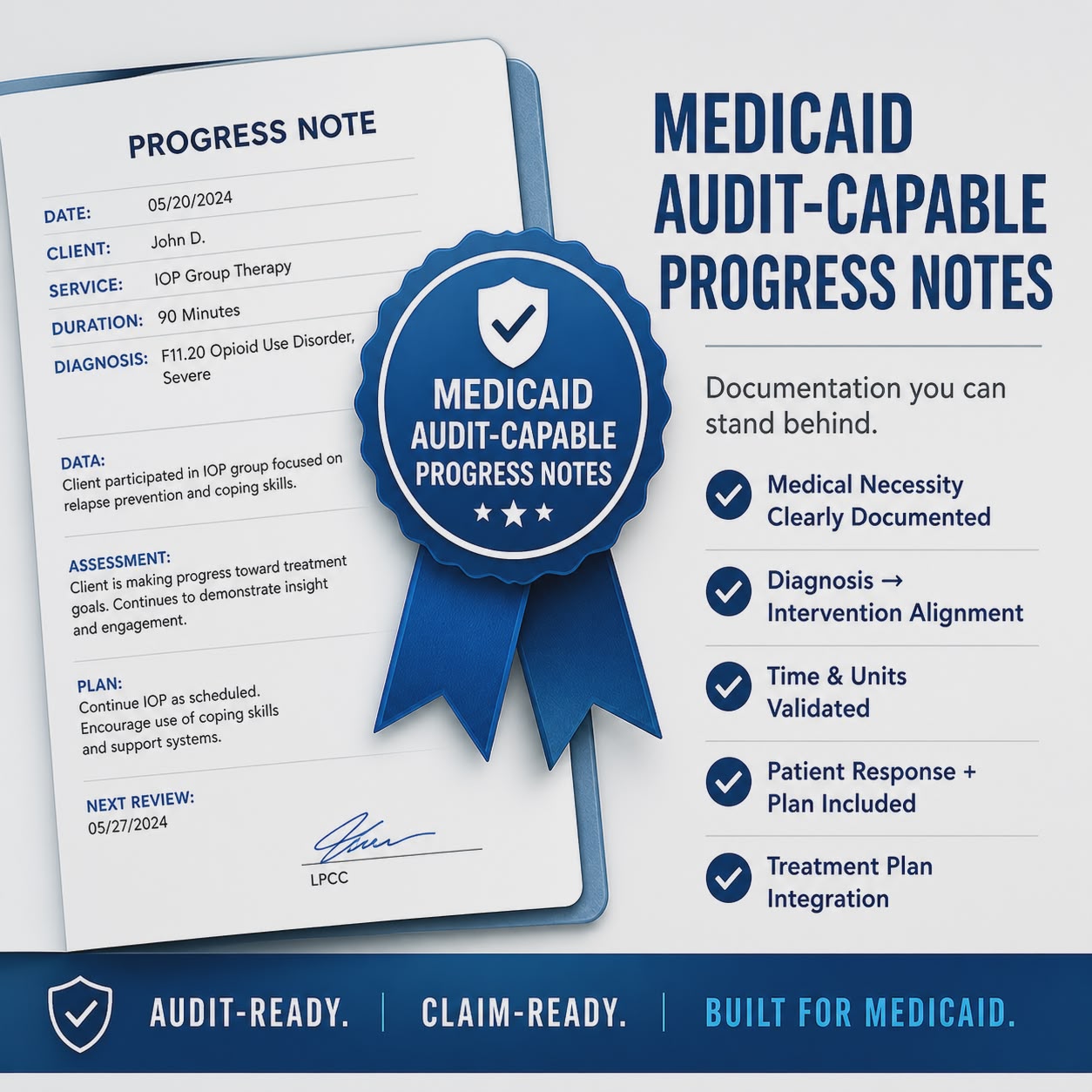
In behavioral health, progress notes are often treated as a formality.
- Something to complete.
- Something to store.
- Something to “get done.”
That approach is exactly why so many practices struggle with denials, audits, and inconsistent revenue.
We took a different path. We slowed down and built progress notes the right way.
The Problem: Most Progress Notes Aren’t Built for Medicaid
Medicaid is not forgiving.
Unlike many other payers, Medicaid programs expect:
- Clear medical necessity
- Tight alignment between diagnosis, intervention, and outcome
- Accurate time and unit reporting
- Consistency across providers and services
- Documentation that supports program-level care such as IOP, SUD, and community-based services
The issue isn’t that clinicians don’t know how to document. It’s that most systems don’t guide them to do it in a way that holds up under scrutiny.
That gap creates:
- Denials
- Recoupments
- Audit exposure
- Revenue leakage
This is one reason many organizations struggle with Medicaid billing behavioral health workflows and long-term compliance.
Our Approach: Documentation as a System, Not a Template
We didn’t start with templates. We started with the full lifecycle:
Scheduler → Session → Note → Daysheet → Claim → Payment
Then we asked a simple question:
What does the note need to contain to ensure the claim gets paid and survives an audit?
And that changed everything.
By integrating documentation directly into behavioral health revenue cycle management workflows, the system supports both compliance and reimbursement performance.
What We Built Differently
1. Structured for Medical Necessity
Every note enforces:
- Diagnosis linkage
- Symptom documentation
- Targeted interventions
- Patient response
- Forward plan
Not as optional fields, but as a guided clinical workflow.
This creates stronger behavioral health compliance and improves Medicaid behavioral health reimbursement outcomes.
2. Aligned With Billing Logic
Clinical documentation and billing cannot be separate systems.
Our notes are built to reflect:
- Service requirements
- Time thresholds and unit logic
- Program and payer expectations
This creates what we call Claims Hygiene, which helps generate clean claims behavioral health workflows before claims are ever submitted.
Integrated documentation also supports RCM for behavioral health by reducing rework and denied claims.
3. Consistency Across Providers
In multi-provider practices, inconsistency leads to risk.
We designed notes to:
- Standardize documentation quality
- Guide providers without slowing them down
- Reduce variability that leads to denials or audit issues
This is especially important for organizations using therapy practice management software and managing multiple clinicians across locations.
4. Built for Real Medicaid Workflows
We didn’t design for ideal scenarios. We designed for reality:
- Multiple services in a single day
- Group and individual sessions
- Program-based care such as IOP, SUD, ACT, and more
- State-specific requirements
This is where most systems break.
We built for it from the start.
Unlike traditional systems, modern behavioral health EHR platforms must support real Medicaid workflows tied directly to billing and operational logic.
The Result: Real World Validation
During a recent Medicaid site visit, a state representative reviewing one of our partner practices said:
“These are the best progress notes I’ve seen.”
That’s not marketing language.
That’s what happens when documentation is engineered with compliance, billing, and clinical care in mind at the same time.
This level of structure is critical for practices managing psychiatry billing Medicaid, substance use treatment workflows, and complex behavioral health programs.
Why This Matters
Progress notes are not just records. They directly impact:
- Revenue through clean versus denied claims
- Compliance and audit readiness
- Operational efficiency with less rework and fewer corrections
When documentation and billing are disconnected, practices often lose 10–20% of potential insurance revenue.
When they’re aligned, performance improves across the board.
Learn how integrated systems improve outcomes through AI behavioral health billing and clean claims workflows and connected documentation systems.
Where This Is Going
This foundation enables what comes next:
- AI-assisted notes that are actually audit-ready
- Measurement-Based Care integrated directly into documentation
- Diagnosis-to-intervention mapping
- Real-time validation before claims submission
The future isn’t faster note-taking.
It’s smarter, enforceable documentation that drives outcomes.
This is where AI progress notes and AI documentation for behavioral health become valuable when integrated into the clinical and billing workflow.
Final Thought
We didn’t rush this.
Because in Medicaid, shortcuts don’t show up immediately. They show up later in denials, audits, and lost revenue.
So we took our time.
And built progress notes that hold up under pressure.
Practices looking for scalable systems should evaluate how their psychiatry EHR and behavioral health billing workflows connect documentation, compliance, and reimbursement into one operational system.
Explore more about the benefits of behavioral and mental health billing services at DENmaar.