Why Structural Instability Is Becoming the Real Risk in Behavioral Health
Most conversations about behavioral health focus on the obvious:
- Staffing shortages
- Burnout
- Reimbursement rates
- Access to care
All real. All important.
But they’re not the biggest threat.
The Real Problem: Structural Instability
Behavioral health practices today are operating in an environment that is becoming:
- Less predictable
- More regulated
- More fragmented
And it’s happening fast.
This isn’t a single issue—it’s a convergence of forces that are reshaping how practices operate.
Medicaid Is Becoming Less Reliable
Behavioral health is heavily dependent on Medicaid.
And right now, Medicaid is changing:
- Eligibility requirements are tightening
- Coverage is fluctuating more frequently
- Provider audits and revalidation are increasing
For practices, this means:
- Patients who were covered last month may not be today
- Eligibility can no longer be assumed
- Claims are more likely to fail due to coverage gaps
This introduces something most practices aren’t designed for:
Constant uncertainty at the point of care
Modern behavioral health EHR software should verify eligibility in real time and reduce Medicaid claims friction.
Funding Is No Longer Stable
Federal and state behavioral health funding has become unpredictable.
Programs expand—and then contract.
Budgets shift.
Policies reverse.
Practices that relied on:
- Grants
- State programs
- Supplemental funding
Are now forced to depend more heavily on:
Consistent, accurate insurance reimbursement
That’s a problem if your system isn’t built for it.
This is why strong mental health billing services and revenue cycle systems matter more than ever.
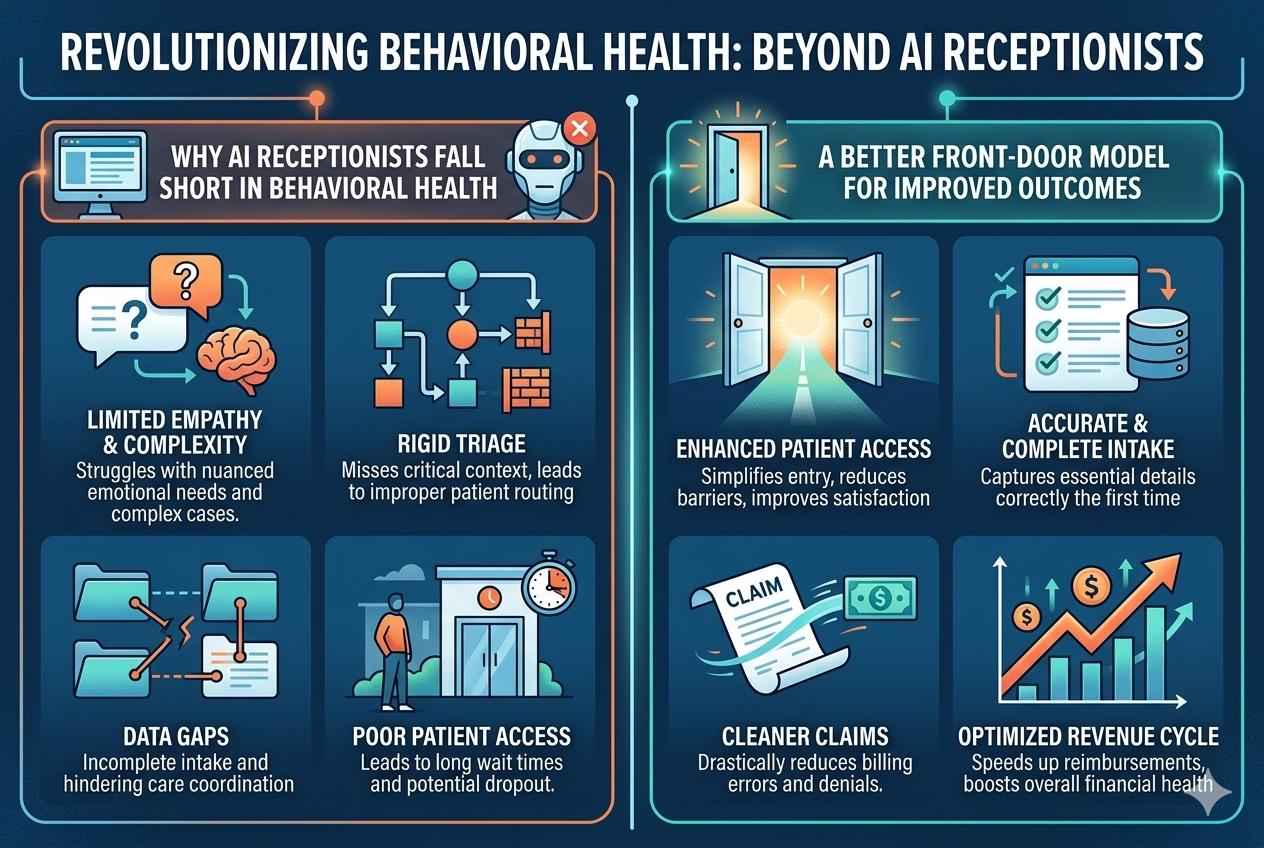
AI Is Rising—But Not Where It Matters Most
There’s a lot of noise around AI in mental health.
- AI therapists
- Chatbots
- Digital companions
But the real opportunity isn’t replacing clinicians.
It’s fixing operations.
The practices that benefit from AI won’t be the ones using it to simulate therapy.
They’ll be the ones using it to:
- Improve documentation
- Enforce workflows
- Prevent billing errors
- Optimize revenue
Solutions like AI behavioral health billing systems and AI progress notes are where measurable ROI happens.
Compliance Pressure Is Increasing
Behavioral health has historically been loosely structured compared to other areas of healthcare.
That’s changing.
There is growing scrutiny around:
- Credentialing
- Documentation
- Billing accuracy
This means:
- More audits
- More denials
- Greater financial risk for mistakes
The margin for error is shrinking.
Practices need stronger behavioral health compliance systems and provider credentialing controls.
The System Most Practices Use Can’t Handle This
Here’s the underlying issue:
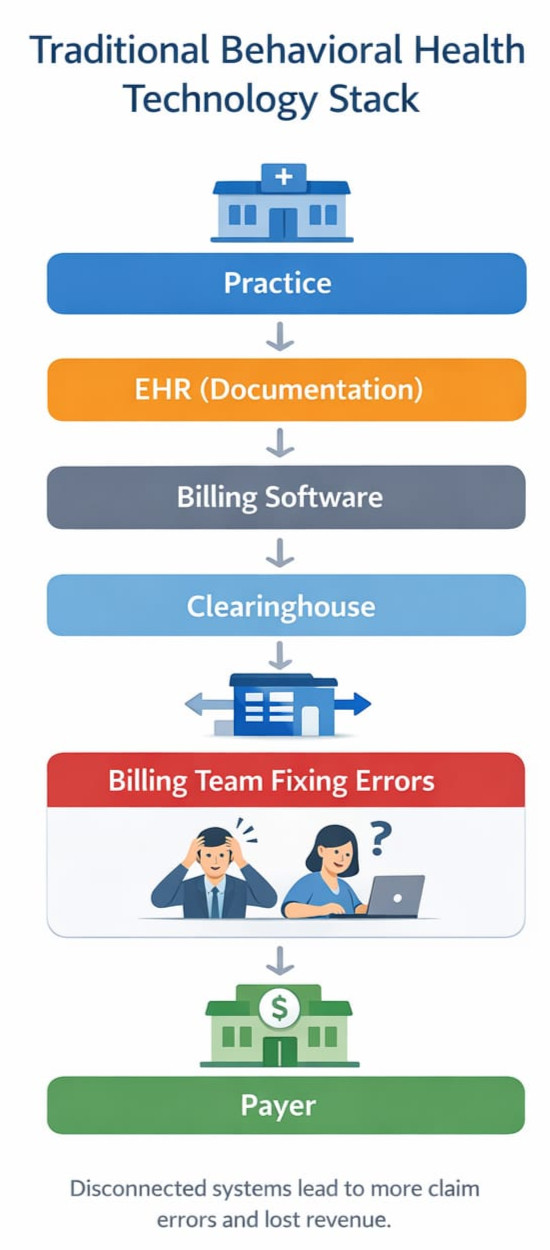
Most practices are still operating with disconnected tools:
- An EHR
- A billing service
- A scheduler
- Manual processes in between
These systems were built for a simpler environment.
They don’t:
- Adapt in real time
- Enforce correct workflows
- Prevent errors before they happen
So when complexity increases, performance breaks down.
Many of these failures are caused by poor claims communication workflows and fragmented processes.
What Needs to Change
The industry doesn’t need another EHR.
It needs a system that functions as a behavioral and financial control layer.
A system that:
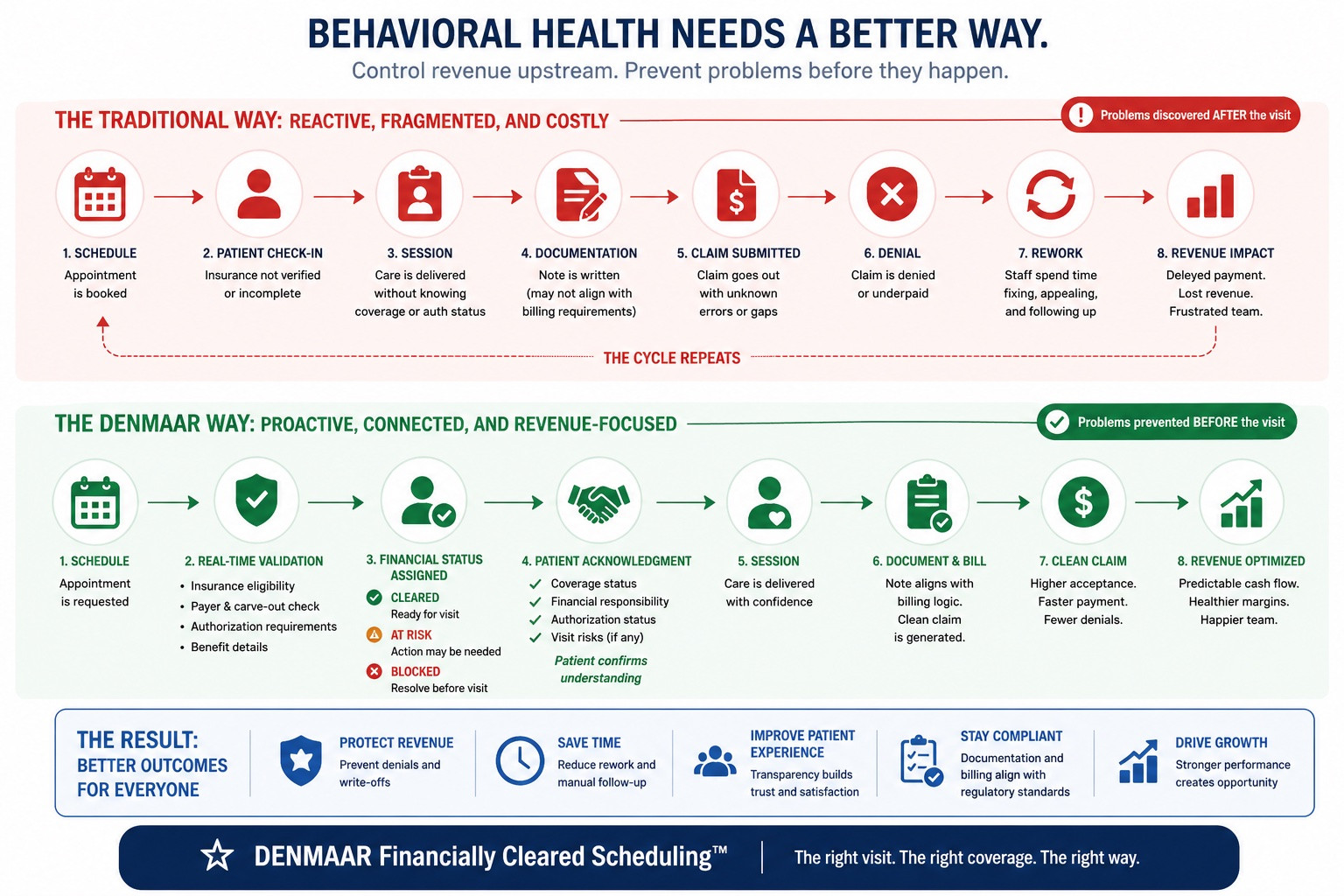
- Validates insurance before the visit
- Detects carve-outs and special workflows
- Confirms authorization requirements
- Aligns documentation with billing logic
- Prevents invalid claims before submission
This is the foundation of claims hygiene in behavioral health billing.
Why the Scheduler Becomes the Most Important Part of the System
If there’s one place to fix this, it’s not billing.
It’s before the session even starts.
At the point of scheduling and check-in.
This is where:
- Coverage can be verified
- Risks can be identified
- Patients can be informed
- Decisions can be made
Once the session happens, the opportunity to prevent errors is gone.
A modern therapy practice management software platform should make scheduling financially intelligent.
A New Standard: Financially Cleared Scheduling
Forward-thinking practices are beginning to adopt a new approach:
Every appointment must be financially validated before care is delivered.
That means:
- Insurance is confirmed
- Authorization is verified
- The correct billing pathway is identified
- The patient acknowledges their financial responsibility
If something isn’t right, it’s addressed before the visit—not after the denial.
Learn how integrated systems like DENmaar make this possible.
The Result
Practices that operate this way see:
- Fewer denials
- Higher clean claim rates
- Faster reimbursement
- More predictable cash flow
Not because they work harder—but because their system enforces the right behavior.
This is true behavioral health revenue cycle management.
Final Thought
Behavioral health isn’t just facing challenges.
It’s entering a more complex, less forgiving operating environment.
The practices that succeed won’t be the ones that react better.
They’ll be the ones that:
Control the system upstream before problems ever occur.