

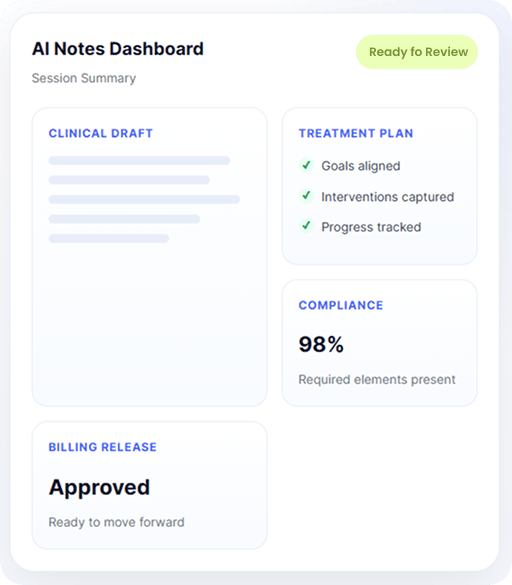
- Presenting problem identified
- Functional impairment documented
- Service is reasonable and necessary
- Treatment is expected to improve condition
AI Notes for Behavioral Health
Spend Less Time Writing Notes.
Spend More Time With Clients
Behavioral health providers face increasing documentation requirements while
trying to maintain quality care. Progress notes, treatment plans, assessments,
supervision documentation, and compliance requirements can consume hours
every week. DENmaar AI Notes helps clinicians complete documentation faster
while maintaining clinical accuracy and professional oversight.

Behavioral Health Focused

Clinical Accuracy & Oversight

Billing Workflow Ready

Reduce Documentation Time
Clinicians save hours each week on documentations.

Improve Note Consistency
AI-powered drafts improve quality and consistency.

Support Compliance Workflows
Build-in guidance for required documentation elements

Connect Notes to billing
Seamless integration with billing and operational workflows.
SUPPORTED DOCUMENTATION
Built Specifically for Behavioral Health
Unlike generic AI scribes, DENmaar AI Notes is designed for behavioral health workflows and
documentation requirements.
Individual Therapy
Family Therapy
Group Therapy
Substance Use Treatment
Case Management
Medication Management
Crisis Intervention
Clinical Supervision
Treatment Plans
Assessments and Reviews
AI NOTES WORKFLOW
How It Works
From captured session details to reviewed, billable documentation.

Record or Capture
Session Information
Patient check-in and
visit completed.

AI Generates a
Clinical Draft
AI Notes generate
structured documentation.

Review and Approve
Claim is created and
scrubbed for accuracy.

Release for Billing
Claim submitted to
the payer
DESIGNED FOR COMPLIANCE
Clinical Documentation with Compliance in Mind
AI Notes helps behavioral health providers document medical necessity, align treatment goals, identify
interventions, and support supervisor review workflows.
Compliance Support
Medical necessity documentation
Goal and treatment plan alignment
Intervention identification
Progress tracking
Required behavioral health documentation elements
Supervisor review workflows
Complete
Medical Necessity Documentation
Documentation supports the medical necessity of services provided and reflects the client’s ongoing treatment needs.
Evidence in Note
Aligned
Goal & Treatment Plan Alignment
Clinical documentation connects session content to active treatment goals and supports continuity across the plan of care.
Evidence in Note
- Active treatment goal referenced
- Session objectives tied to treatment plan
- Interventions support documented goals
- Progress linked back to care plan
Verified
Intervention Identification
Notes clearly identify the therapeutic interventions used during the session and how they relate to the client’s needs.
Evidence in Note
- Therapeutic intervention documented
- Intervention matched to presenting concerns
- Clinician actions clearly described
- Modality or technique identified where appropriate
Reviewed
Progress Tracking
Session documentation captures the client’s response to treatment and tracks change over time to support clinical decision-making.
Evidence in Note
- Client response to intervention documented
- Progress toward goals addressed
- Barriers or setbacks identified
- Ongoing symptoms or improvements noted
Included
Required Documentation Elements
Behavioral health notes include the core documentation elements needed for completeness, consistency, and payer readiness.
Evidence in Note
- Session date, duration, and service type included
- Relevant clinical observations documented
- Risk, safety, or notable concerns addressed when applicable
- Required note structure completed for the encounter
Available
Supervisor Review Workflow
Documentation can support internal review and approval workflows, helping supervisors monitor quality, accuracy, and compliance.
Evidence in Note
- Draft available for supervisor review
- Revisions or feedback can be incorporated
- Approval status is clearly tracked
- Final documentation is released after sign-off
MORE THAN A SCRIBE
Documentation Connected to the Rest of Your Workflow
Documentation can connect directly to scheduling, treatment plans, assessments, billing workflows, claims validation,
and provider productivity reporting.

Scheduling

Assessments

Claims Validation

DENmaar AI
Notes
Notes

Treatment Plans

Billing Workflows

Productivity Reporting
WHY ORGANIZATIONS CHOOSE DENMAAR
Built for Behavioral Health Teams and Organizations
DENmaar AI Notes is designed to support real-world clinical documentation and operational workflows.

Behavioral Health Focused
Customizable behavioral health workflows including therapy, psychiatry, substance use treatment, and multidisciplinary care models.

Scheduling & Operational Workflows
Integrated scheduling designed to support provider productivity, patient flow, authorization tracking, and claims readiness.

Supervisor Workflows
Built-in workflow logic designed to improve claim accuracy before submission through integrated operational checks and billing intelligence.

Eligibility & Insurance Verification
Integrated eligibility workflows designed to support Medicaid, commercial insurance, carve-outs, and behavioral health payer complexity.

Patient Engagement
Patient portal, intake workflows, secure communication, reminders, and measurement-based care tools.

Request an
AI Notes Trial
See how DENmaar AI Notes can help your clinicians reduce documentation time while improving
Request a demonstration or pilot program today.
Request Information
TESTIMONIALS
WHAT OUR CLIENTS SAY
On behalf of everyone at Meadowlark Counseling Services, I want to extend our sincere thanks for the continued improvements you and your team have made to the DENMaar EMR platform. We have been consistently impressed with both the functionality and user-friendly design of the system, which has made a meaningful difference in our day-to-day operations. The intuitive layout and ease of use have allowed our staff to spend less time navigating the system and more time focusing on client care. The regular updates and enhancements reflect your commitment to meeting the evolving needs of providers in the behavioral health and substance use treatment fields. We genuinely look forward to the new features introduced each month and appreciate how responsive the platform has been to the demands of clinical workflows. We have been so pleased with our experience that we’ve taken the opportunity to recommend DENMaar to other professionals in Pennsylvania who are working in the SUD field. Thank you again for your ongoing support and partnership. We are grateful to be working with a company that truly understands the needs of its users. KIndly, Becky Parks on behalf of the entire team at Meadowlark Counseling Services
I referred one of my colleagues Dr Aaron to you he is just starting g his psychology private practice and looking at where to start. I told him hands down you guys are the best billers and have a great EMR and team. He said he reached out just wanted to let you know!
FANTASTIC job keeping things rolling along with any and all of our billing concerns as well as responding to other issues which may well have been out of your wheelhouse. We are VERY grateful to have you and the crew in our corner.
I appreciate you all so much and DENmaar has been such a blessing Donna to our overall operations and success as an expanding company—allowing us to ultimately operate more efficiently, get our claims paid more consistently, ad stay on top of the critical credentialing piece, among other things. Teamwork does in fact, make the dream work. I’ll loop Chris/Isabella in on this message thread too, as I want All of your team to be aware of how much we appreciate our working relationship with DENmaar
Thank you for your diligence!! I appreciate it so much. Thank you Edwina…
Thank you so much Amy! I will be referring to DENmaar as often as I am asked about credentialing services.
Our Latest Blogs

Your Behavioral Health Technology Partner Shouldn’t Leave You on Your Own
Technology should make a behavioral health practice easier to operate, not leave its team alone to connect the pieces.
By Chris Husted, CEO of DENmaar
Behavioral health practices are often told that the right software will solve their operational problems. They implement an EHR, add a billing platform, connect a scheduling tool, and perhaps purchase separate systems for patient communication, eligibility, telehealth, and documentation.
Yet the work rarely becomes simpler. Instead, the practice is left responsible for making all those systems work together and for discovering where the process is breaking down.
That is the problem with treating software as a product that is delivered rather than a working relationship that continues.
A Help Desk Is Not the Same as Behavioral Health Operational Support
Traditional software support usually begins after something goes wrong. A user submits a ticket, describes the issue, and waits for an answer. That model may address technical defects, but many of the hardest problems inside a behavioral health practice do not fit neatly into a support ticket.
A claim may be unpaid because eligibility was not verified correctly, a payer applied an unexpected rule, documentation did not support the service, or responsibility for the next action was unclear. A provider may be falling behind on notes because the workflow creates unnecessary steps. Front office staff may repeatedly request the same information because scheduling, intake, and billing are disconnected.
These are not isolated software problems. They are operational problems that cross clinical, administrative, and financial workflows.
The Software Should Reflect How the Practice Actually Works
Behavioral health practices have distinct workflows, payer requirements, staffing structures, and service lines. They should not have to reorganize their entire operation around a generic system.
A strong Behavioral Health Technology Partner listens to the people doing the work. It identifies repeated friction, determines whether the cause is a process, payer, training, or product issue, and then helps create a practical solution. Sometimes that means improving the software. Sometimes it means clarifying accountability. Often it requires both.
At DENmaar, many of our most useful improvements come directly from working alongside practices. Their real world requests help us build capabilities that are useful not only for one organization, but across the platform.
Clinical and Financial Workflows Belong Together
An EHR should not end its job when the provider signs the note. The clinical record, patient information, eligibility results, authorization requirements, charge release, claim status, and follow up activity are all connected.
When those functions live in separate systems, practices lose visibility. Staff members create spreadsheets, duplicate information, and spend time determining what happened rather than moving the work forward.
Bringing the EHR, billing, and operational workflows together creates a clearer chain of responsibility. A practitioner can see whether documentation is complete, whether a claim was released, what remains unpaid, what action has been taken, and what needs to happen next.
This approach to behavioral health practice management helps connect clinical and financial workflows instead of forcing teams to manage them separately.
Every Problem Should Lead to Greater Visibility
Software should do more than store information. It should help a practice answer basic operating questions quickly: What needs attention today? Which claims are stuck? Why are they stuck? Who is working for them? Which patients need updated insurance information? Which providers have incomplete documentation?
When those answers are visible, management can act earlier. Staff members spend less time searching. Providers receive clearer direction. Problems become work items with owners and next steps instead of unresolved surprises.
Effective behavioral health workflow automation can help organizations improve operational efficiency while giving teams greater visibility into the work that requires attention.
What a True Behavioral Health Technology Partner Looks Like
A true technology partner does not disappear after implementation. It remains involved, learns from the practice, and continues improving the combination of technology and human support.
That close working relationship matters because no two behavioral health practices operate exactly the same way and because payer rules, documentation expectations, and patient needs continue to change.
The goal is not simply to provide more features. The goal is to make the practice easier to operate, give leadership greater control, and allow clinicians and staff to spend more time on work that matters.
This is where behavioral health operational support becomes more than traditional software support. It means helping practices address the operational challenges that exist across technology, workflows, billing, and day to day practice management.
DENmaar Was Built Around That Idea
DENmaar brings behavioral health software, billing, and operational support together in one system. We work closely with practices to solve problems, strengthen workflows, and continually improve the platform based on what is happening in the real world.
For practices looking to improve how they manage patient communication and front office workflows, an AI receptionist for behavioral health can also become part of a more connected operational approach.
Because your software vendor should not leave you on your own. It should help your practice move forward.
DENmaar’s approach focuses on connecting technology with measurable practice outcomes rather than simply adding another system for staff to manage.
Frequently Asked Questions
What is a Behavioral Health Technology Partner?
A Behavioral Health Technology Partner combines software, operational guidance, workflow support, and ongoing improvements for behavioral health practices.
Why does behavioral health need operational support?
Behavioral health practices manage complex clinical, administrative, billing, and payer workflows that often require coordinated operational support.
What should behavioral health software support include?
It should include workflow guidance, technical assistance, billing support, operational improvements, and help connecting clinical and financial processes.
How can technology improve behavioral health operations?
Connected technology can reduce duplicate work, improve visibility, automate repetitive workflows, and help teams identify problems earlier.
What makes a behavioral health technology partner different?
A true partner stays involved after implementation, learns from the practice, improves workflows, and combines technology with human support.

Are EHRs Dead? The Future of Behavioral Health Practice Management
The traditional EHR is. What comes next will run the entire practice.
For decades, electronic health records promised to transform healthcare. In many ways, they did. Paper charts became digital. Records became searchable. Notes could be stored, signed, and retrieved more easily.
But somewhere along the way, the industry confused digitizing the chart with improving the practice.
Most EHRs remain systems of record. They store what has already happened: the appointment, the diagnosis, the clinical note, the claim, and the payment. They document the past, but they do very little to manage what needs to happen next.
That model is reaching the end of its useful life.
The EHR is not disappearing. The patient record will always matter. But the traditional, passive EHR, the electronic filing cabinet, is dead.
Practices do not need another place to enter information
Behavioral health practices are surrounded by disconnected work:
- A patient requests an appointment.
- Insurance must be verified correctly.
- Benefits and patient responsibility must be understood.
- Intake forms and assessments must be completed.
- The provider must document the session accurately and on time.
- The correct claim must be created and submitted.
- Rejections and denials must be identified and corrected.
- Unpaid claims must be followed until resolved.
- Patient balances must be collected and reconciled.
- Management needs to know where revenue is being lost.
In a traditional EHR, people are responsible for remembering, checking, transferring, and following up on nearly every step. The software holds the information, but the practice still has to run the process manually.
That is why adding another dashboard or another reporting screen is not enough. Practices do not simply need more visibility into unfinished work. They need a system that actively moves the work forward.
The next generation will be a practice operating system
The future is not an EHR with a few AI features attached. It is an intelligent operating system built around the complete administrative, clinical, and financial workflow.
That system should know what needs to happen next—and help make it happen.
It should:
- guide intake and scheduling;
- verify eligibility before the appointment;
- identify benefits and expected patient responsibility;
- help collect the correct amount from the patient;
- prompt providers to complete required documentation;
- assist with compliant clinical notes and assessments;
- create accurate claims from the clinical and scheduling data;
- detect rejected, denied, delayed, or underpaid claims;
- assign follow-up work to the right person;
- track every unresolved dollar through payment;
- give leadership a clear picture of performance and accountability.
Instead of waiting for someone to find a problem, the system should recognize it, surface it, and help resolve it.
AI should reduce work, not create another tool to manage
Artificial intelligence is often presented as a separate feature: an AI note writer, chatbot, or reporting assistant. Those tools can be useful, but isolated AI does not solve the larger problem.
The real value comes when intelligence is built throughout the workflow.
An AI receptionist can help capture a prospective patient, answer common questions, and begin intake. Documentation assistance can help the provider produce a complete, clinically appropriate note. Claims intelligence can compare the appointment, documentation, coding, eligibility, authorization, and payer requirements before submission. Revenue-cycle automation can identify claims that require attention and keep them moving until they are paid.
Each part should strengthen the next. Scheduling data should support documentation. Documentation should support coding. Coding should support clean claims. Payment information should update patient responsibility. Unresolved claims should automatically become visible, assigned work.
That is not a collection of features. It is one connected system.
The measure of an EHR should no longer be whether it stores the chart
The better questions are:
- Does it reduce administrative work?
- Does it make providers’ lives easier?
- Does it prevent revenue from falling through the cracks?
- Does it tell each team member what requires attention?
- Does it connect the clinical record to the financial outcome?
- Does it help management understand what is working, what is stuck, and why?
A modern platform should not merely document the practice. It should help operate the practice.
From software the practice uses to a system the practice runs on
At DENmaar, we believe behavioral health organizations need more than an EHR and more than a billing service. They need a complete system dedicated to improving the journey from the first patient call through clinical care, claim submission, and final payment.
That means connecting scheduling, intake, eligibility, benefits, patient payments, clinical documentation, claims, follow-up, and management visibility. It means combining intelligent automation with experienced revenue-cycle support. And it means giving smaller practices enterprise-level capability without enterprise-level complexity.
So, are EHRs dead?
The electronic patient record is not. But the passive EHR, the system that stores information while people do all the work around it, is already being replaced.
The future belongs to platforms that do more than record the practice.
They help run it.
Frequently Asked Questions
What is behavioral health practice management?
Behavioral health practice management coordinates clinical, administrative, and financial workflows to help practices operate efficiently and deliver care.
How is AI changing behavioral health practice management?
AI can automate repetitive workflows, support documentation, identify claims issues, and help teams prioritize work across the practice.
What is a behavioral health practice operating system?
It is an integrated system that connects scheduling, intake, documentation, billing, claims, payments, and operational workflows.
Are traditional EHRs becoming outdated?
Traditional EHRs remain important for patient records, but practices increasingly need systems that actively manage workflows beyond documentation.
Why does behavioral health need integrated technology?
Behavioral health involves complex clinical, administrative, insurance, and billing workflows. Integrated technology helps connect these processes and reduce manual work.

Behavioral Healthcare Technology for Growing Practices: Enterprise Capability. Small Practice Simplicity
For years, behavioral healthcare technology has forced practices into a difficult choice.
You can buy an enterprise platform with hundreds of features, months of implementation, and a level of complexity that requires dedicated administrators.
Or you can buy software designed for small practices that is easy to use, but quickly becomes limiting as your organization grows.
We believe there should be a better option.
At DENmaar, our vision is simple:
Enterprise capability. Small practice simplicity.
Who We’re Building For with Behavioral Healthcare Technology
We’re not trying to build software for every healthcare organization.
We’re building for growing behavioral healthcare organizations with approximately 2 to 15 providers, including:
- Therapy practices
- Psychiatry practices
- Multidisciplinary behavioral health
- Substance Use Disorder (SUD) programs
- Intensive Outpatient Programs (IOP)
- Community behavioral health organizations
- Integrated behavioral health practices
These organizations face enterprise-level challenges without enterprise-level resources.
They need to manage documentation, scheduling, insurance eligibility, credentialing, billing, denials, patient responsibility, compliance, and provider productivity, all while continuing to care for patients.
Growing Practices Deserve Better
Many practices eventually discover that they have outgrown their software.
As providers are added, workflows become more complicated.
As insurance volume increases, revenue cycle management becomes more demanding.
As services expand into psychiatry, therapy, group treatment, or IOP, disconnected systems create additional work instead of reducing it.
Growing should not require replacing your technology every few years.
Your software should grow with you.
One Platform
Our goal is to eliminate the need for multiple disconnected systems.
Instead of stitching together separate products for documentation, billing, credentialing, eligibility, and workflow management, we believe these functions should work together as one platform.
That means less duplication.
Less administrative work.
Less time searching for information.
More time caring for patients.
Our integrated approach combines AI Notes for Behavioral Health, intelligent workflows, and Claims Copilot to help organizations improve efficiency while delivering better outcomes, rather than simply adding more software.
Learning From Real Practices
We believe the best products are built alongside the people who use them.
Every implementation teaches us something.
Some organizations challenge us with scale.
Others introduce new clinical workflows.
Every improvement we make becomes part of the platform for every future customer.
That’s how software should evolve, not through assumptions, but through real-world experience.
Our Promise
We’re not trying to build the biggest healthcare platform.
We’re focused on building the most practical platform for growing behavioral healthcare organizations.
A platform that combines AI, billing, revenue cycle management, credentialing, scheduling, eligibility, and clinical documentation without unnecessary complexity.
Because growing practices deserve enterprise-level capabilities.
Without enterprise-level complexity.
Enterprise capability. Small practice simplicity.
That’s the future we’re building.
Frequently Asked Questions
What is behavioral healthcare technology?
Behavioral healthcare technology connects clinical, billing, and operational workflows to improve efficiency and patient care.
Why use behavioral healthcare technology?
It helps practices reduce administrative work, improve productivity, and support sustainable growth.
How do AI notes help providers?
AI notes reduce documentation time while improving accuracy and supporting clinical compliance.
What is Claims Copilot?
Claims Copilot helps identify claim issues early and supports faster reimbursement through intelligent workflows.
How can growing practices scale?
Growing practices scale by using connected platforms that simplify operations and improve financial performance.
Our Partners





Ready to get started?
Feel free to reach out if you have any questions.
