

- Session transcription
- DAP, SOAP, and BIRP progress notes
- Psychiatry and medication-management documentation
- Biopsychosocial assessments
- Individualized treatment plans
- Measurable goals and objectives
- Group and multidisciplinary documentation
- Integration of clinical assessments and outcome measures
- Continuity between the treatment plan and subsequent notes
AI Notes for Behavioral Health
AI Built Into the
Work of the Practice.
From the first patient call through documentation, claims, and payment.
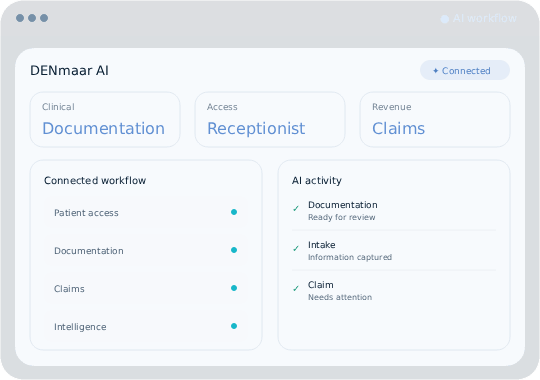
DENmaar applies AI across the connected workflow of a behavioral health practice—not only to generate progress notes.
Because DENmaar brings the EHR, scheduling, billing, credentialing, and operational support into one platform, AI can help move work forward across the entire organization.
One platform. One connected workflow. AI where the work actually happens.

Behavioral Health Focused

Clinical Accuracy & Oversight

Billing Workflow Ready
AI Notes
More Than an AI Note Generator
Most healthcare AI products solve one isolated task. They may transcribe a session, generate a note, answer a call, or analyze a claim—but the practice is still responsible for connecting those tools.
DENmaar takes a different approach.
We are building AI directly into the clinical, administrative, and financial workflows already used by the practice.
Information collected during intake can support documentation. Documentation can help prepare the claim. Claim information can guide billing follow-up. Operational data can help leadership see where work is becoming delayed.
The result is not simply more AI features. It is a more connected practice.
How DENmaar Uses AI
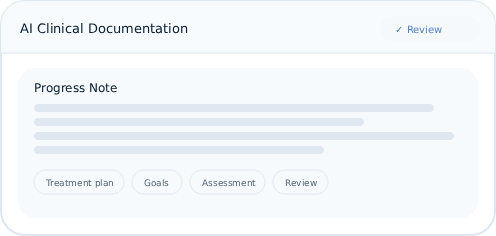
AI Clinical Documentation
Create behavioral health documentation using information already available within the patient record.
Providers remain in control. AI-generated content can be reviewed, edited, and approved by the clinician before it becomes part of the signed record.
How DENmaar Uses AI
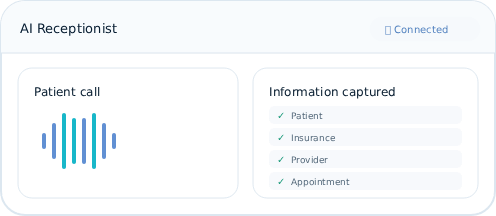
AI Receptionist
Respond to patients and prospective patients even when staff members are unavailable.
The DENmaar AI Receptionist is being designed around the real intake and scheduling needs of behavioral health organizations.
- Immediate call response
- New-patient information collection
- Appointment requests
- Rescheduling requests
- Common practice questions
- Insurance-information collection
- Provider and location routing
- After-hours coverage
- Call summaries and recommended follow-up
Because the AI Receptionist is connected to the DENmaar platform, the information it collects can become part of the practice workflow instead of remaining inside a separate answering service.
How DENmaar Uses AI
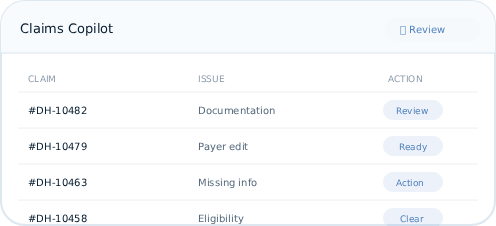
Claims Copilot
Help staff identify potential claim problems before they become lost revenue.
Claims Copilot brings AI and operational intelligence into the revenue-cycle workflow. It is designed to help billing teams understand what needs attention, why it needs attention, and what should happen next.
- Reviewing claims for missing or inconsistent information
- Identifying documentation and billing dependencies
- Highlighting claims that require follow-up
- Organizing work by urgency and financial impact
- Supporting denial and rejection analysis
- Recommending the next action
- Surfacing recurring payer or workflow problems
- Helping prevent avoidable delays before submission
Claims Copilot does not replace billing judgment. It gives the billing team better information and a clearer path through the work.
How DENmaar Uses AI
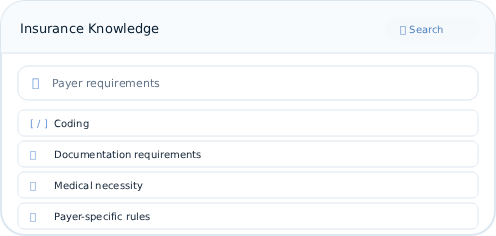
Insurance Knowledge
Turn years of behavioral health billing experience into accessible guidance.
Insurance requirements change constantly and often vary by payer, plan, state, provider type, and service. DENmaar is developing an expanding insurance knowledge resource informed by real behavioral health billing situations.
It can support questions involving:
- Coding
- Prior authorization
- Medical necessity
- Documentation requirements
- Claim resolution
- Credentialing
- Telehealth requirements
- Payer-specific rules
- Billing best practices
Instead of leaving practices to search scattered payer manuals or depend on disconnected information, DENmaar brings insurance knowledge closer to the workflow where decisions are made.
How DENmaar Uses AI
Intelligent Provider Workflow
Help every provider understand what requires attention next.
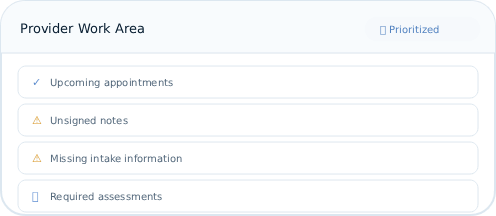
DENmaar’s Provider Work Area is being developed to organize clinical and administrative responsibilities into a single, prioritized view.
It will help providers identify:
- Upcoming appointments
- Missing intake information
- Eligibility or insurance concerns
- Incomplete documentation
- Unsigned notes
- Required assessments
- Treatment-plan updates
- Supervisor review requirements
- Other actions that could delay care or billing
The goal is simple: providers should not have to search through multiple screens to discover what they need to do.
How DENmaar Uses AI
Practice and Revenue Intelligence
Give leadership a clearer view of how the organization is operating.
By bringing scheduling, clinical documentation, provider activity, claims, and collections together, DENmaar can help practice leaders identify:
- Provider utilization
- Unfinished clinical work
- Workflow bottlenecks
- Claims waiting on documentation
- Recurring insurance problems
- Revenue-cycle exceptions
- Operational trends requiring attention
AI becomes most valuable when it helps the organization recognize problems earlier and take action before those problems affect patients, providers, or revenue.
Connected Patient Journey
One Patient Journey.
One Connected System.
The value of DENmaar’s AI is not limited to any single feature.
ONE CONNECTED WORKFLOW
AI working across the practice, from first contact through revenue-cycle operations.
01
PATIENT ACCESS
A prospective patient contacts the practice.
02
AI RECEPTIONIST
The AI Receptionist collects information and helps move the request into the appropriate scheduling or follow-up workflow.
03
INTAKE
The patient completes registration, insurance information, and assessments.
04
DOCUMENTATION
The provider uses those records and the session information to prepare clinical documentation.
05
BILLING READINESS
The completed documentation supports claim creation and billing readiness.
06
CLAIMS COPILOT
Claims Copilot helps identify exceptions and directs the billing team toward the next action.
07
PRACTICE INTELLIGENCE
Practice leadership can see where clinical, administrative, or financial work is becoming delayed.
THE CONNECTED OUTCOME
That is AI working across the practice—not another application working by itself.
Practice & Revenue Intelligence
AI That Helps the Organization
See What's Next
Connected data gives DENmaar more context about where work is happening, where it is delayed, and where
attention can have the greatest operational impact.
Prioritize Work
Surface the tasks and exceptions that need attention instead of making staff hunt for them.
Find Bottlenecks
Identify recurring workflow problems across clinical, administrative, and revenue-cycle operations.
Act Earlier
Recognize patterns before unfinished work becomes a patient-access, billing, or revenue problem.
Support Providers
Give clinicians a clearer view of documentation and administrative responsibilities.
Keep Humans in Control
AI assists the work while clinicians and staff retain responsibility for decisions.
Connect the Workflow
Use information already present in the DENmaar platform rather than recreating it in another tool.
Behavioral Healthcare
Designed for Behavioral Healthcare
DENmaar’s AI capabilities are built around the needs of behavioral health organizations, including:
Therapy
Psychiatry
Substance use disorder treatment
Group services
Multidisciplinary care
Multi-provider and multi-location practices
AI assists the work, but clinicians and staff retain responsibility for reviewing information and making clinical, administrative, and billing decisions.
DENmaar AI
Built Today. Expanding Continuously.
DENmaar is introducing AI carefully across the platform. Some capabilities are available today, while others are in development or being expanded through controlled pilots.
During a demonstration, we will show you what is currently available, explain what is being developed, and evaluate which DENmaar workflows fit the needs of your organization.
No inflated promises. No disconnected AI tools. A practical path toward a more intelligent behavioral health practice.
Available today
Controlled pilots
Expanding continuously
Request an
AI Notes Trial
See how DENmaar AI Notes can help your clinicians reduce documentation time while improving
Request a demonstration or pilot program today.
Request Information
TESTIMONIALS
WHAT OUR CLIENTS SAY
On behalf of everyone at Meadowlark Counseling Services, I want to extend our sincere thanks for the continued improvements you and your team have made to the DENMaar EMR platform. We have been consistently impressed with both the functionality and user-friendly design of the system, which has made a meaningful difference in our day-to-day operations. The intuitive layout and ease of use have allowed our staff to spend less time navigating the system and more time focusing on client care. The regular updates and enhancements reflect your commitment to meeting the evolving needs of providers in the behavioral health and substance use treatment fields. We genuinely look forward to the new features introduced each month and appreciate how responsive the platform has been to the demands of clinical workflows. We have been so pleased with our experience that we’ve taken the opportunity to recommend DENMaar to other professionals in Pennsylvania who are working in the SUD field. Thank you again for your ongoing support and partnership. We are grateful to be working with a company that truly understands the needs of its users. KIndly, Becky Parks on behalf of the entire team at Meadowlark Counseling Services
I referred one of my colleagues Dr Aaron to you he is just starting g his psychology private practice and looking at where to start. I told him hands down you guys are the best billers and have a great EMR and team. He said he reached out just wanted to let you know!
FANTASTIC job keeping things rolling along with any and all of our billing concerns as well as responding to other issues which may well have been out of your wheelhouse. We are VERY grateful to have you and the crew in our corner.
I appreciate you all so much and DENmaar has been such a blessing Donna to our overall operations and success as an expanding company—allowing us to ultimately operate more efficiently, get our claims paid more consistently, ad stay on top of the critical credentialing piece, among other things. Teamwork does in fact, make the dream work. I’ll loop Chris/Isabella in on this message thread too, as I want All of your team to be aware of how much we appreciate our working relationship with DENmaar
Thank you for your diligence!! I appreciate it so much. Thank you Edwina…
Thank you so much Amy! I will be referring to DENmaar as often as I am asked about credentialing services.
Our Latest Blogs
Benefits of Telehealth Technology for Hospitals
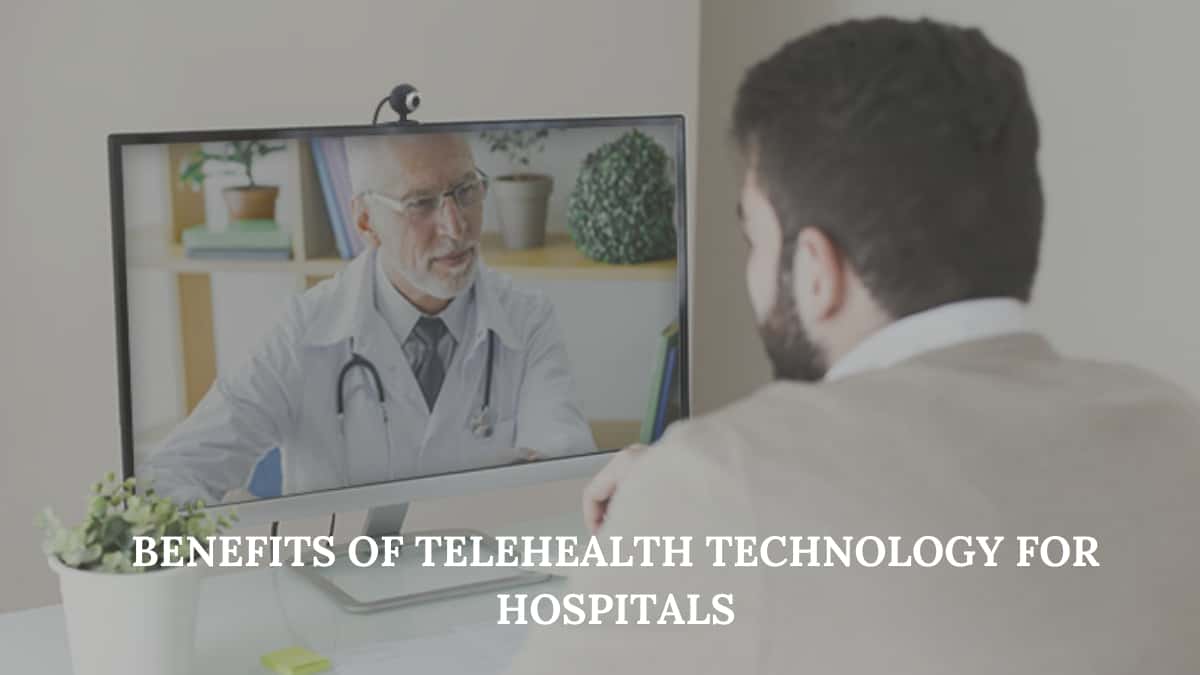
We know how important Telehealth technology has been in transforming health care. We know of the benefits it offers to both Patients and Providers alike. Some of which are as follows
- Improved Access to Healthcare
- Cutting Wait Time
- Making Health care affordable
Individuals are already taking full advantage of this revolutionary technology. They have mobile apps installed in their smartphones, and wearables on their wrist or shoulders to track their fitness. We know of the benefits that patients can have with telehealth. However, what are the benefits of telehealth on hospitals, clinics and other healthcare organizations.
In this article, we look at some of the benefits that hospitals and other healthcare organizations can enjoy by using Telehealth technology.
The many uses of Telehealth Technology on Healthcare Institutes and Organizations
Increased Revenue
Access to healthcare, for many American even today, is extremely challenging. Factors like transportation, distance to a nearby clinic etc. all play an important role in being hurdles for the proper access of healthcare. This can be even more inconvenient in cases of senior citizens or people with disabilities.
These individuals can barely make it to a clinic or hospital for proper care. However, with the help of telehealth technology, doctors and other practitioners can still schedule appointment and consult them live via a videoconferencing or live video tool. So, these individuals, who would normally have never become a part of client base, can now become your most valuable clients, thanks to Telehealth.
The same rationale applies to people who don’t have access to healthcare due to them residing in rural or remote regions. They too can be catered to with the help of telehealth technology.
Greater Visibility
It is widely estimated that most people prefer telehealth over physical visits. According to a study done by American Well, it was found that over 65 percent of patients want to see their doctors over video.
The rendering of virtual visits, mHealth apps, and remote patient monitoring solutions, a healthcare organization can attract positive media attention. Positive media attention, then eventually leads to new clients.
Reducing Readmissions
Telehealth technology like RPM solutions can help keep tabs on patients who are considered high-risk. With the help of real-time patient data being provided by this technology, care teams can act immediately before the patient’s condition worsens.
Hospitals are always seeking reduced readmission rates, more satisfied customers and avoiding penalties for subpar healthcare. A robust telehealth technology can help you accomplish that.
Increasing Productivity
Hospitals and Healthcare institutes are busy places. As such doctors and nurses have a lot on their plate, and are constantly on their toes. Telehealth, by imbuing efficiency into the overall functioning of a hospital helps in boosting the productivity of their staff.
Telehealth helps patients schedule their own appointments, which means this burden is alleviated from the shoulders of the staff. Mobile communication also enables staff to collaborate effectively with each other. With so many mundane tasks taken care of, the staff can focus better on their patients.
Better training
The science of medicine undergoes perpetual evolution. As such, people who practice medicine need to be constantly educated and informed of the developments in the world of healthcare. However, this can be very expensive. Some training programs charge exorbitantly high registration fees.
Thankfully, video conferencing technology today can help physicians attend training sessions remotely from the comfort of their own abode, without spending a ton of money. Virtual reality training solutions are also becoming very popular nowadays. They allow physicians to observe recorded surgeries from multiple angles and undergo simulation that offer hands-on experience to learn new techniques and procedures.
DENmaar’s TeleHealth Services
At DENmaar, our telehealth solution offers both patients and providers with a communication technology that allows the access and management of health care services from homes of patients or the practices of doctors. This tele-conferencing feature allows practitioners to attend to their patients, on their computer screens, where-in they can consult and serve their clients without having to make them wait in their clinics or making them transit long distances.
All you have to do to access our feature, whether you are a provider or patient, is to sign up to our app and avail our telepsych feature.
The Present and Future of Telehealth Mental Health Care in the Workplace
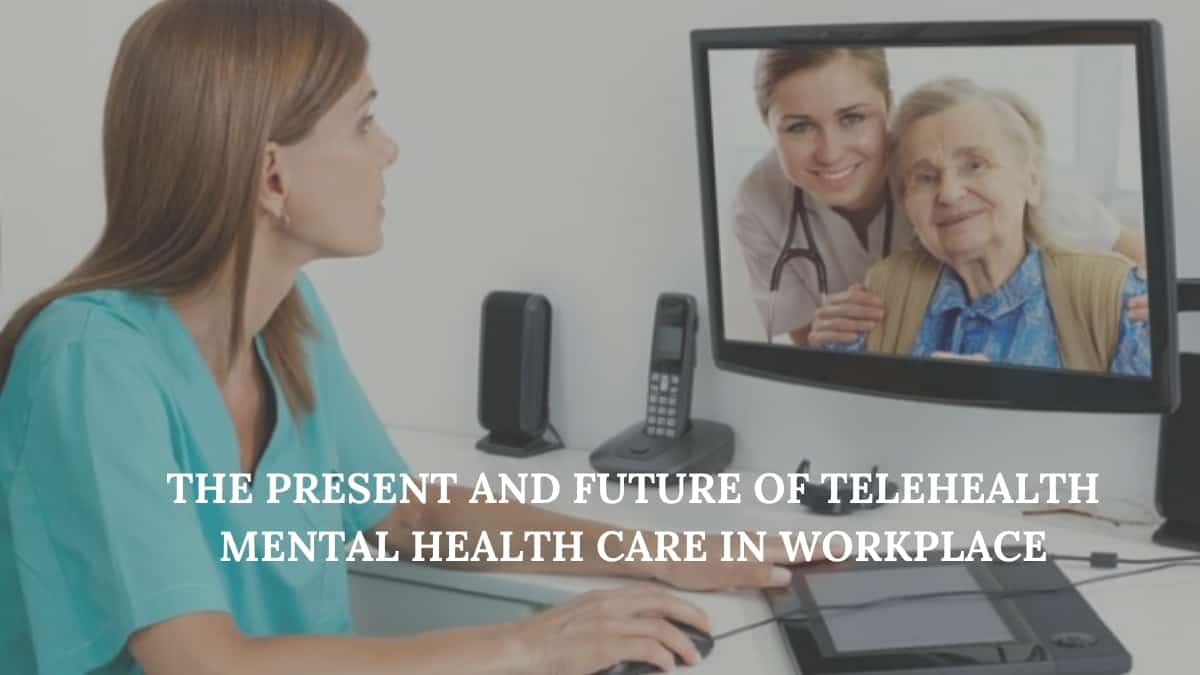
The ongoing coronavirus crisis has already galvanized people into self-isolation. The isolation has already resulted in great stress among individuals across the US. Over 16 million Americans are estimated to be suffering from some form of depression; this number is likely to go up as the pandemic wreaks havoc on the streets.
As a result, many workers today are relegating to their employer provided mental health plans, widely encouraged by the employers themselves. They have realized the gravity of the disruption caused on their employee’s normal way of life, and how it can lead to unfathomable stress. There has also been a significant increase in the number of therapy sessions.
Telehealth in Workplace
Telehealth Mental health platforms like Ginger have noticed a rise in their user base as well. This shows that employees are now turning to telehealth technology to find reprieve from their mental health problems. Glass – a company that deploys their tool to help users find behavioral health practitioners have reported a 25% increase in their client base. Modern health – a virtual mental health app, on the other hand, has reported a 50 % increase in their user base.
Headspace, a popular meditation app has also found a substantial increase in their users. They say that meditation on their app has become 13 times more often than any previous month. Headspace’s user base is mostly filled with Google and LinkedIn employees. Taking advantage of this opportunity, they have proceeded to create a free content hub to provide guided meditation and mental health exercises as the global lockdown continues.
So as you can see, many telehealth apps are experiencing feats of success that they never dreamed of achieving. Addressing mental health has become a priority amongst businesses, who really want their employees to sail through these troubled seas without any problems whatsoever. Employees too, are relying on the available technology and programs in unprecedented numbers. Although mental health program existed before the pandemic hit, it had never been as popular as it is now.
Many Employers are actively encouraging users to take advantage of the EAP resources at the disposal of their employees. It is in times of such anxiety and uncertainty that behavioral health practitioners like counselors and psychiatrists are needed. However, with social distancing in effect, it is impossible to attend therapy sessions. This is precisely why Telehealth has come out as such a champion.
Employers understand how crucial their staff’s mental health is. In times where conference, meetings and other office practices have halted, mental health care has become a need of the hour for employees to maintain their productivity.
It is estimated that people with mental health issues report 20% drop in their productivity. Companies have no choice but to think about the safety and wellbeing of their employees. Apart from work, the desire for some form of human connection has also lead to such technology gaining momentum, thus helping users connect with their loved ones.
The Future of Telehealth Mental Health Care
Many epidemiologists have delivered warning signs of a yearlong fight with the novel coronavirus. In other words the virus is here to stay. In such a scenario, the work cannot be halted for an extended period of time. People will need to learn how to live with the crisis, and as a result people will need constant counseling. Thankfully, telehealth has never as advanced as it is today. With telehealth, you can rest assured your bread and butter continues while taking care of your mental health. Yes, the virus is here to stay, but so is the omniscient presence of telehealth.
DENmaar’s TeleHealth Services
At DENmaar, our telehealth solution offers both patients and providers with a communication technology that allows the access and management of health care services from homes of patients or the practices of doctors. This tele-conferencing feature allows practitioners to attend to their patients, on their computer screens, where-in they can consult and serve their clients without having to make them wait in their clinics or making them transit long distances.
All you have to do to access our feature, whether you are a provider or patient, is to sign up to our app and avail our telepsych feature.
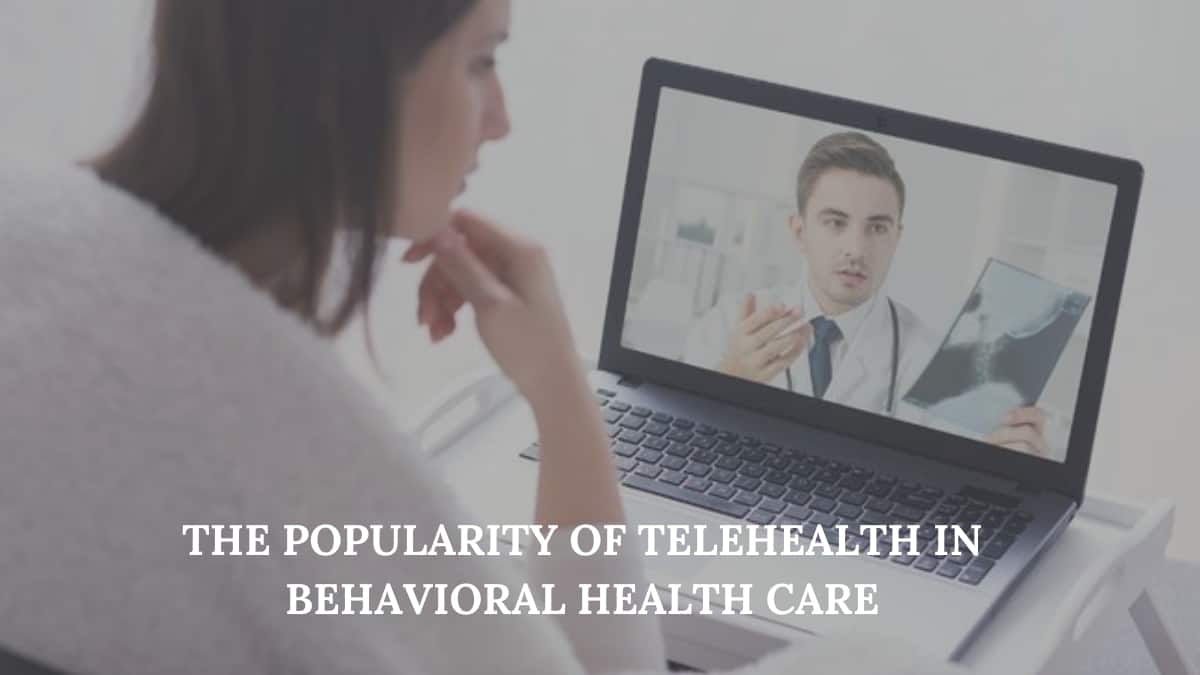
The Popularity of Telehealth in Behavioral Health Care
We’ve come a long way since the early days of telehealth. With constant advancements, innovations, and updates in technology, Telehealth has become relatively potent as opposed to its beginning years. Its relevance has been proven even more fundamental, owing to the current pandemic.
Read More: How to Expand Private Practice Using Telemedicine
Almost all healthcare practices, organizations, and professionals are now implementing technology to not only provide consistent care to their clients but also ensure their practice remains open for business. This is especially true for the behavioral health care sector as well. The implementation of Telehealth in Behavioral health has made mental health care better, more cost-effective, and less stigmatized.
Telehealth’s major selling point has always been its accessibility. It can be a tool that transcends socio-geographical barriers to ensure better care is delivered on time whenever needed. Rural areas have greatly benefited from Telehealth.
How is Telehealth used in Behavioral Health?
Most behavioral health practices are aligned with psychiatry, counseling, and cognitive tests, there is barely any physical involvement in the rendering of behavioral health care. As such Telehealth and behavioral health go hand in hand. Behavioral professionals can still deliver efficient care via a mobile device with the help of telehealth.
Moreover, treating mental health with telehealth is easier, and cheaper as treatment is rendered in a virtual ambiance. There is also a stigma around mental health treatment, which dissuades many individuals from coming forward with their woes. It is estimated that about 42 million Americans have anxiety disorders, and at least 16 million are suffering from some form of depression. Telehealth, by providing a virtual incentive, helps patients get proper mental health care comfortably.
There are multiple research materials claiming that mental health issues come with medical comorbidity. For individuals who deal with multiple conditions like hypertension and depression at the same time, they can get the answers to their queries from a single virtual point, thus allowing for better access to care.
There are other incentives to telehealth as well. Patients no longer have to wait in long lines with patients who might carry contagious flu, which is one of the reasons why telehealth’s stock is up nowadays. There is also no long-distance travel, especially for residents of rural regions. There was a time when rural residents had to traverse on overnight journeys just to see a doctor. Telehealth has changed that.
The adoption of telehealth is already showing results in the behavioral space. According to the popular telehealth service Teladoc’s own research, practitioners have seen an impressive improvement in the mental health of their clients using telehealth. They have reported a 32% reduction in depression symptoms, a 31% reduction in anxiety, and a 20 percent reduction in stress.
DENmaar’s TeleHealth & Medical Billing Services
At DENmaar, our telehealth solution offers both patients and providers with a communication technology that allows the access and management of health care services from homes of patients or the practices of doctors. This teleconferencing feature allows practitioners to attend to their patients, on their computer screens, where-in they can consult and serve their clients without having to make them wait in their clinics or making them transit long distances.
All you have to do to access our feature, whether you are a provider or patient, is to sign up to our app and avail our telepsych feature.
Our Partners






Ready to get started?
Feel free to reach out if you have any questions.
