Nobody gets excited about an unsigned note.
Until it holds up payment for three weeks.
Nobody applauds when an intake gets completed, a treatment plan gets reviewed, or an attendance discrepancy gets caught before billing.
But ask the person who spends Friday afternoon chasing those things. They might have a different definition of exciting.
Much of the conversation about healthcare AI centers on what it can generate: a note, an answer, a summary. Those capabilities have a place. Yet a particularly useful opportunity sits in the everyday work surrounding patient care.
The work that someone still has to remember.
AI Workflow Automation in Behavioral Health Starts With Follow-Through
Consider an ordinary day in a behavioral health practice.
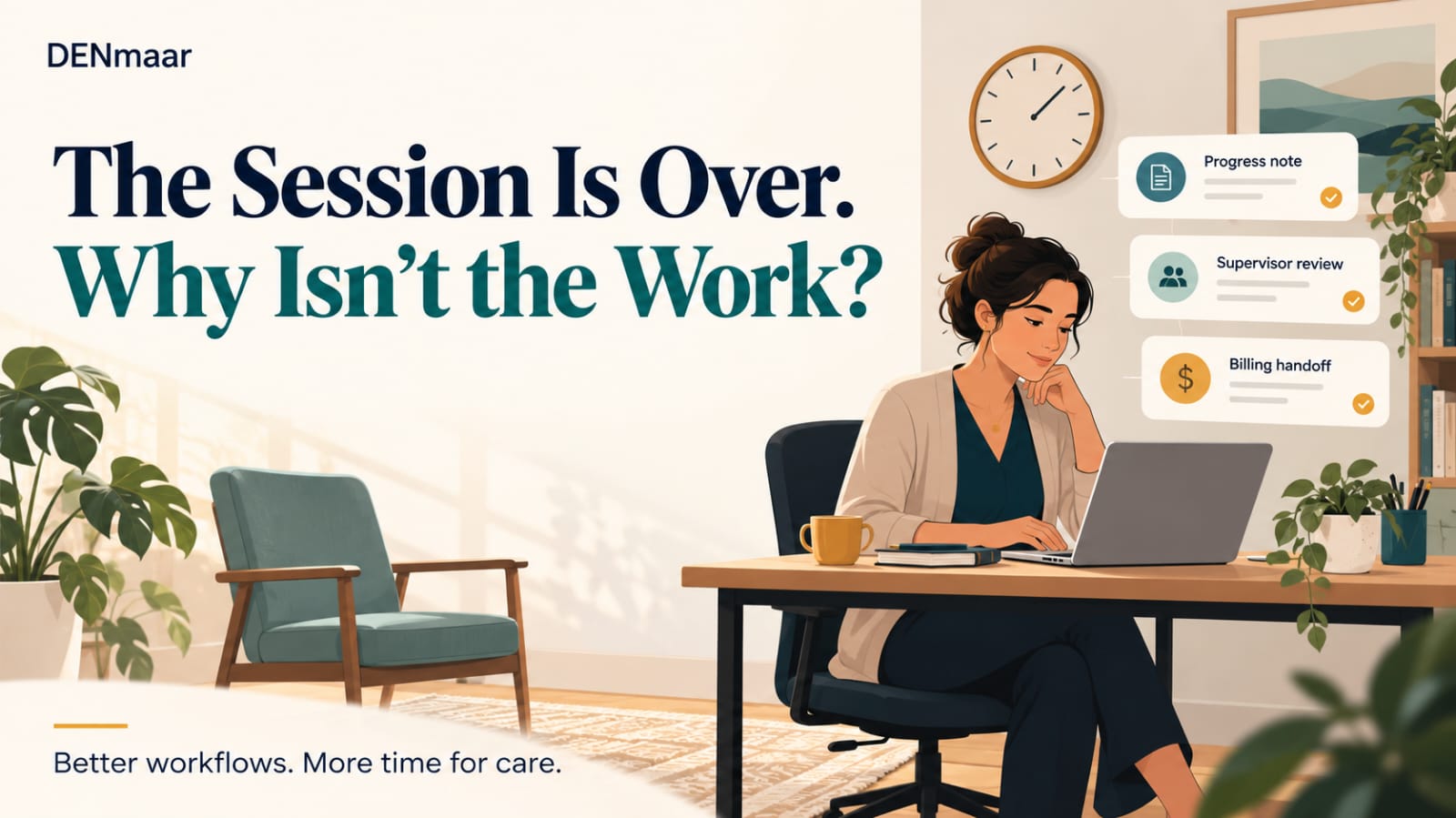
A prospective patient starts an intake but never finishes. A provider completes a session but leaves documentation unfinished. A treatment plan needs review. A supervisor has a note waiting for a signature. A billing specialist needs one missing detail before moving a claim forward.
Each item looks small on its own. Together, they create a second workload: checking, reminding, searching, and asking whether something got done.
Often, an experienced staff member becomes the practice’s unofficial memory. They know which screen to check, whom to remind, and what will fall through the cracks if they take a day off.
That is a lot to ask of one person’s memory.
Give AI a Useful Job
Imagine AI helping identify an unfinished note and bringing it into the provider’s work queue with the relevant appointment attached.
Or surfacing a treatment plan due for review alongside the patient’s recent assessments, so the clinician can decide what needs to change.
Or flagging a difference between scheduled group time and recorded attendance, allowing staff to verify what happened before billing review.
Or identifying an incomplete intake and preparing a follow-up for staff to review.
These are practical opportunities for AI-enabled workflows. Their value depends on accurate information, clear rules, and appropriate human oversight. Clinical decisions belong with clinicians, and billing decisions must account for the applicable payer requirements.
The goal is to make the next necessary action easier to see and complete.
Another Alert Is Not Enough
A reminder that sends someone searching through five screens still leaves plenty of work behind.
Useful automation needs context. Which task needs attention? Who is responsible? What is the next step? Is there a dependency that must be resolved first?
A better behavioral health documentation workflow makes outstanding work easier to identify and helps providers, supervisors, and billing teams understand where responsibility moves next.
AI should support this process, not replace professional judgment. Clinical decisions remain with clinicians, and staff should retain appropriate oversight of administrative and financial actions.
The goal is not more alerts. It is fewer unresolved tasks.
Less Chasing. More Room to Work.
For a provider, the benefit might be ending the day with fewer loose ends. For billing staff, it might be receiving documentation ready for review. For an owner, it might be seeing where work is stalled without personally investigating every case.
For patients, better follow-through could mean an intake that keeps moving or a review that happens when it is due.
These are the outcomes worth designing for, and measuring. How long does work sit unfinished? How many times must the staff touch it? Are issues resolved earlier? Do people spend less time chasing one another?
What We Are Building Toward at DENmaar
At DENmaar, this thinking is shaping our development direction: connecting the scheduler, clinical documentation, treatment planning, work areas, and billing so that information supports the next step in the practice’s work.
Our aim is to make AI useful within those everyday workflows, with people able to review, decide, and act.
The most valuable AI in healthcare might be boring.
But getting home with fewer unfinished tasks on your mind? That sounds pretty good.
Want to explore how DENmaar could support your practice workflows? Contact our team to discuss your needs or request a conversation.