

A claim has been outstanding for 35 days. The clearinghouse shows it was accepted, but the payer portal still says “in process.” The practice wants to know whether anything is holding up payment and who’s following up.
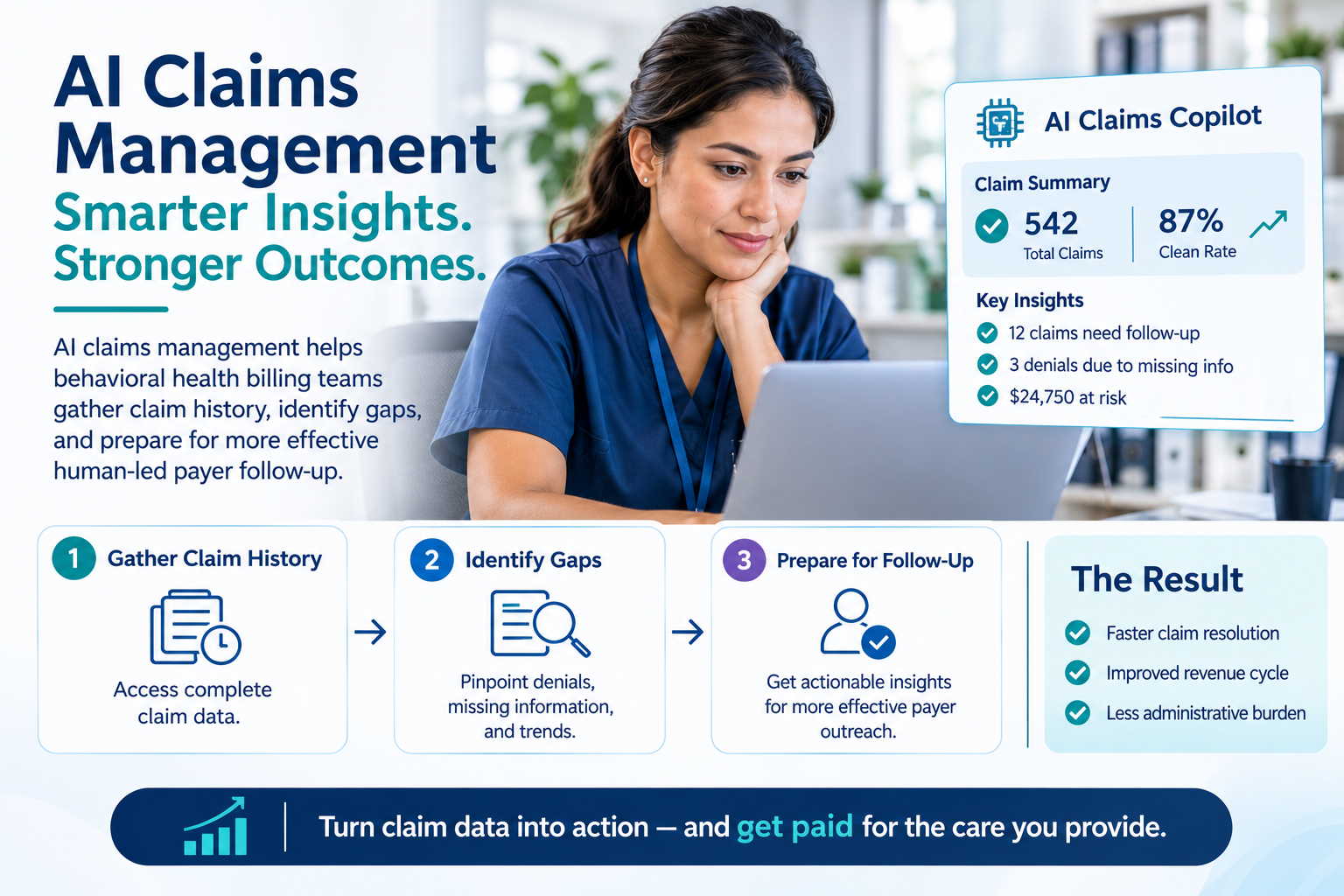
Before anyone can answer, someone has to pull the claim history, check for a remittance, review prior follow-up, and see whether a response is already due. AI can help gather that information. If the payer’s status still leaves the practice’s question unanswered, a billing specialist can use that history to ask a more specific question.
AI can help gather that information through tools designed for AI-powered claims management.
What AI Can Do in Claims Management Before the Call?
A claims workflow can bring together clearinghouse acknowledgments, payer responses, remittance information, and notes from prior follow-up. AI can summarize that history and point out gaps or conflicting information. Each finding should show where it came from and when it was last checked.
In this case, the summary might show that the clearinghouse accepted the submission, the payer last reported it was in process, and no remittance has been posted. That gives the specialist a starting point. The payer still needs to clarify whether the claim is moving through adjudication or waiting for something from the practice.
What the Conversation Adds to Claim Follow-Up?
A billing specialist can ask the payer whether there’s a specific hold, whether any documentation is needed, and when the payer expects to act. If the practice needs to provide something, the specialist can explain exactly what’s needed and follow up with the person who can get it.
The same approach works across therapy, psychiatry, substance use treatment, and IOP and PHP programs. The claim details vary by service. The person handling the issue still needs enough context to ask the right question, recognize an incomplete answer, and carry the follow-up through.
Make Claim Ownership Visible in the Billing Hub
At DENmaar, that’s the principle behind how we’re designing the Billing Hub. When a claim stalls, the practice should be able to see the latest verified status, what’s already been tried, who owns the next action, and when it’s due.
The practice still has a person who knows the claim and can see it through, supported by behavioral health billing services that help manage the billing process.
That can make the next update specific: “The payer confirmed the claim is waiting for a document. Your billing specialist will coordinate with your office and verify receipt after it’s submitted.”
AI helps the specialist walk into that conversation prepared. The practice still has a person who knows the claim and can see it through.
Inspired by AI Automation Works. And That’s the Problem.