

Artificial intelligence is becoming part of the conversation around electronic health records (EHRs) and revenue cycle management (RCM). But answering a question and completing a workflow are different capabilities.
For a behavioral health practice, that difference matters. A useful answer can save time. A system that helps move work toward completion can change how the practice operates.
Agentic AI in EHR and RCM Systems
A chatbot provides a conversational interface. Depending on its connections and permissions, it may answer questions, explain information, summarize records, or draft content.
A provider might ask, “What documentation is still incomplete?” A billing specialist might ask, “What does this denial reason mean?”
An assistant connected to the appropriate data could identify unsigned notes or explain a denial. Staff would then take the next steps.
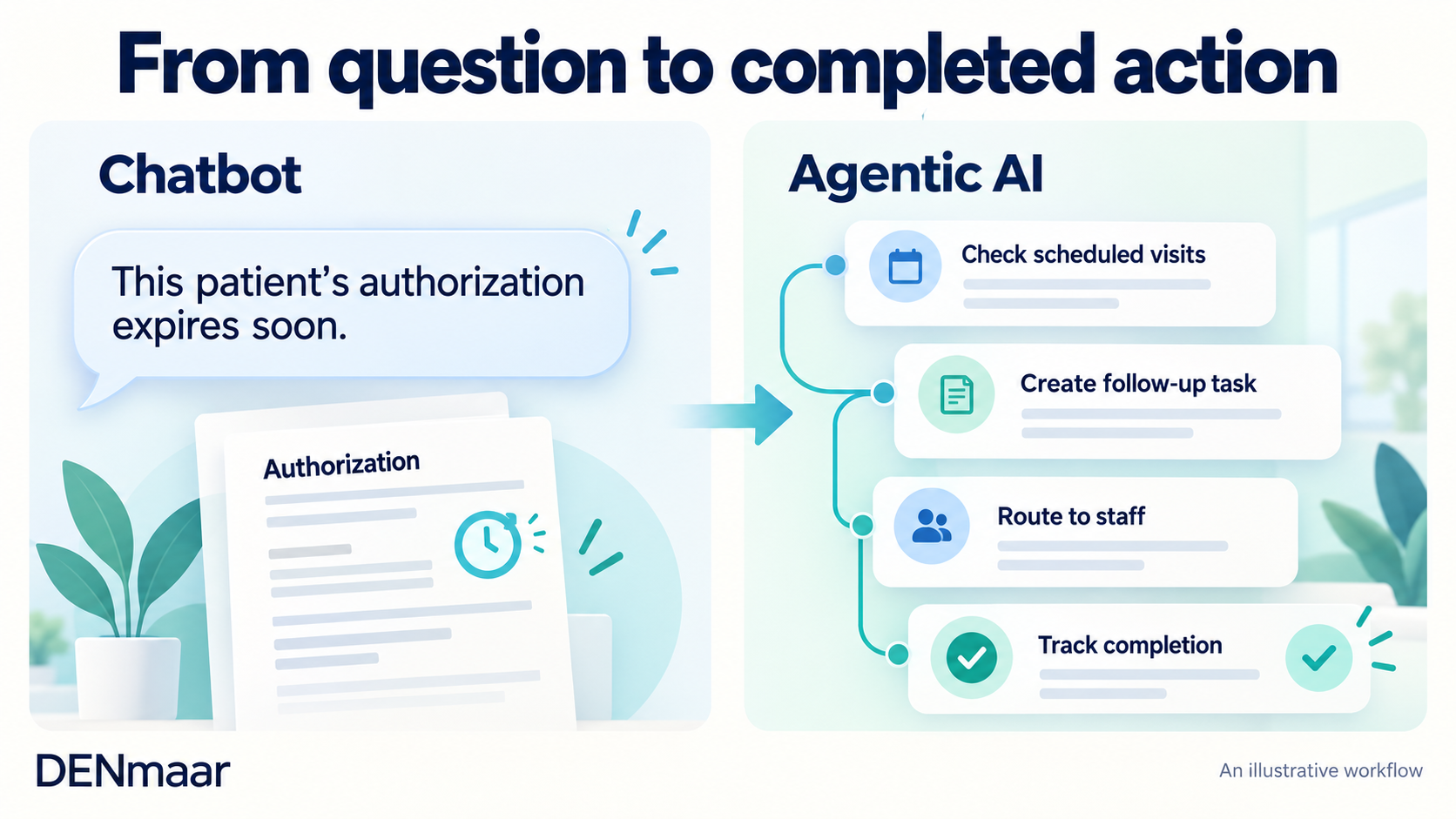
Instead of only explaining an authorization issue, an agent could check the authorization record, compare it with upcoming appointments, create a follow-up task, and route it to the appropriate employee.
Agentic AI can use connected tools to pursue a defined goal through multiple steps. It can select an available action, examine the result, and determine what should happen next within its permissions.
Instead of only explaining an authorization issue, an agent could check the authorization record, compare it with upcoming appointments, create a follow-up task, and route it to the appropriate employee.
These are illustrative possibilities, not claims that every EHR or RCM platform offers them today. For a broader look at agentic AI in behavioral health, the focus is on how carefully defined AI assistance could support everyday practice workflows.
Chatbots and Agentic AI: The Capability Difference
The distinction is also more nuanced than “chatbots talk, agents act.” A chatbot can be the interface through which a user directs an agent. What matters is the capability behind the conversation: which records it can access, which tools it can use, and how its work is controlled.
For provider documentation, conversational assistance could list incomplete notes and summarize what needs attention. An agentic workflow could prioritize outstanding work, open the relevant items, and route reminders or review tasks.
For authorization tracking, conversational assistance could explain recorded visit limits and dates. An agentic workflow could compare authorization data with scheduled services and assign exceptions for review.
For claim denials, conversational assistance could summarize a denial and suggest possible next steps. An agentic workflow could retrieve related claim details, prepare a follow-up task or draft correction, and route it for approval.
For patient billing, conversational assistance could explain a balance using available account information. An agentic workflow could check unresolved insurance activity and prepare an approved outreach workflow for staff review.
The benefit is fewer manual handoffs between identifying an issue and addressing it.
Agentic AI in EHR Workflows Needs More Than Automation
However, a scheduled reminder or a fixed rule is ordinary automation. It does not become agentic simply because a vendor adds an AI label. Agentic behavior involves selecting next steps based on the goal, available information, and results.
In an EHR or billing system, action needs accountability.
A practical design should limit access by role, record what the AI did, and clearly show what was completed, what failed, and what still requires attention. Missing or conflicting information should trigger review rather than a confident guess.
Clinical decisions, note signatures, coding changes, claim submissions, and financial adjustments need controls appropriate to their consequences. An agent may prepare work while a qualified person retains approval authority.
Eligibility results also should not be presented as a guarantee of payment. Moving faster does not remove the need to verify the underlying information.
Agentic AI in EHR: A Practical Starting Point for DENmaar
For DENmaar, the Provider Work Area is a practical place to connect conversational assistance with the work providers need to complete.
A useful first step is helping a provider see what needs attention and reach it more easily. Further development can focus on specific workflows where AI can prepare, route, or complete approved steps.
Success should be measured through everyday results: fewer clicks, fewer unresolved tasks, less duplicate work, and more timely completion.
The question practices should ask is simple: Does the AI only describe the work, or can it help move the work forward with clear permissions and visible results?
That is the difference that matters.
The healthcare workflow examples above are proposed applications, not documented DENmaar product capabilities.
Background Sources
OpenAI Agent definitions-> https://developers.openai.com/api/docs/guides/agents/define-agents
OpenAI Running agents-> https://developers.openai.com/api/docs/guides/agents/running-agents
OpenAI Guardrails and human review-> Guardrails and human review | OpenAI API